
The Evolution of Hybrid DLT: From Permissioned Ledgers to Public Networks
Discover how hybrid distributed ledger architecture enables financial institutions to balance privacy, compliance, interoperability, and liquidity by combining the strengths of permissioned and public blockchain networks.

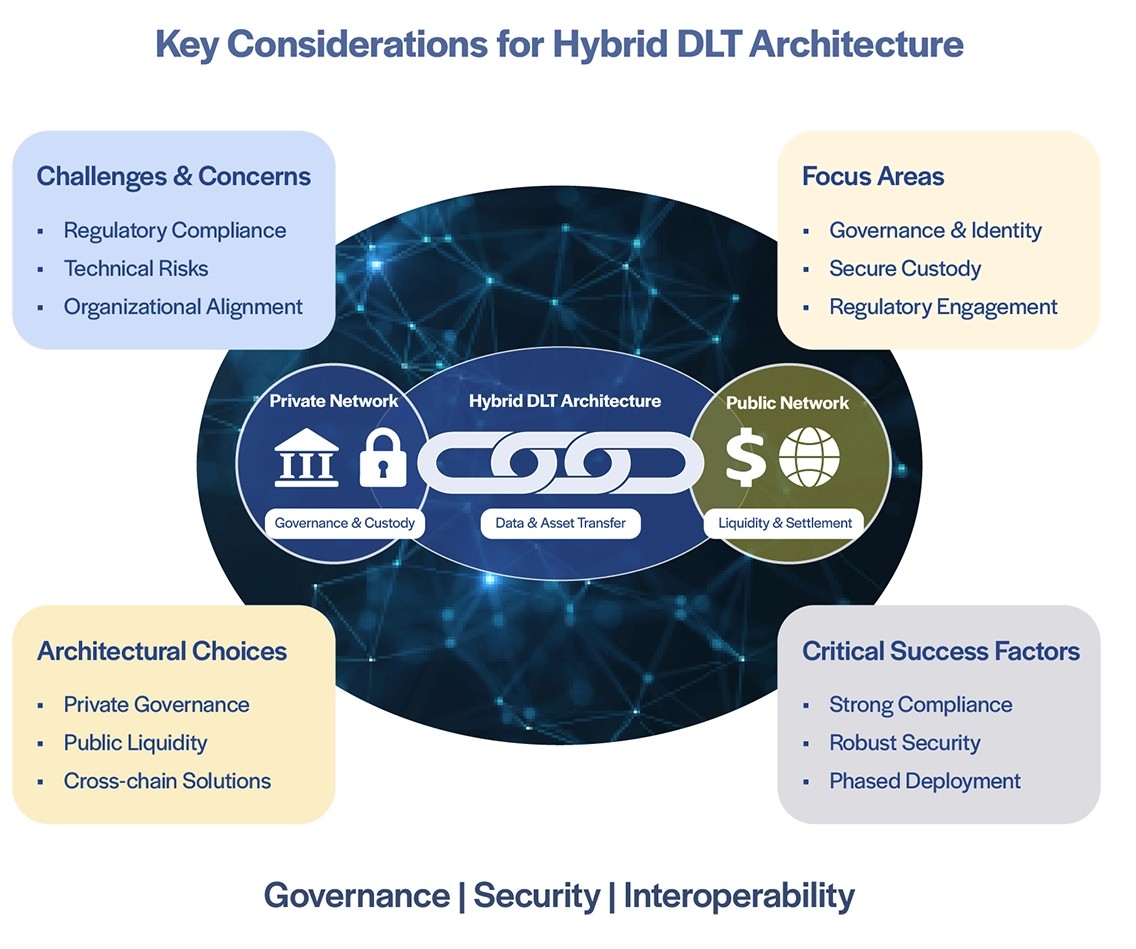
Financial institutions are accelerating their digital asset and blockchain initiatives but choosing between public and private distributed ledger technologies (DLTs) remains a significant challenge. While public networks offer transparency, interoperability, and access to global liquidity, they often fall short of institutional requirements for privacy, governance, and regulatory compliance. Permissioned DLTs address these concerns but can limit interoperability and market reach.
Hybrid DLT architecture is emerging as the next stage in distributed ledger evolution by combining the strengths of both models. Sensitive business processes, governance, and regulatory controls remain within permissioned environments, while public blockchain networks enable secure settlement, broader market access, tokenized asset distribution, and programmable financial services. This approach allows organizations to unlock innovation without compromising security or compliance.
Successfully implementing a hybrid architecture requires more than connecting two networks. Organizations must carefully address governance, identity management, interoperability, cross-chain communication, custody, regulatory alignment, cybersecurity, and enterprise integration. Architectural decisions around asset lifecycle management, smart contracts, cross-chain bridges, and compliance frameworks play a critical role in ensuring secure and scalable deployments.
Leading financial institutions are already demonstrating how hybrid DLT can support tokenized assets, improve operational efficiency, expand liquidity, and bridge traditional finance with decentralized finance. As regulatory frameworks continue to mature, hybrid architectures are expected to become the preferred foundation for enterprise blockchain adoption.
Read our perspective paper to explore the evolution of hybrid DLT, understand the key architectural considerations for successful implementation, and learn how financial institutions can build secure, compliant, and future-ready digital asset ecosystems.