Accelerate your agile software development

Accelerate your agile software development

Businesses are increasingly using cloud technologies and service-oriented architectures to deliver their products and services on digital channels. They also want those IT solutions delivered increasingly faster. In order to meet those demands, IT has adopted Agile methodology to reduce time to develop new capabilities, apply fixes and deploy them to production.

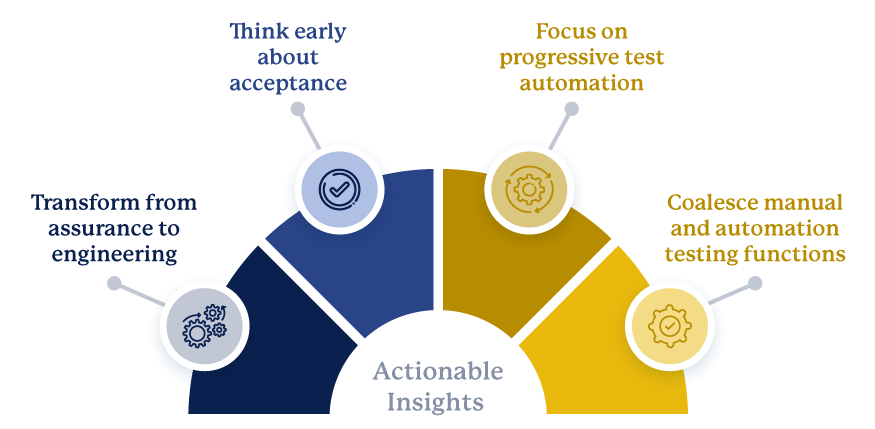
    The nature of software development is transforming with more frequent releases and monolithic architecture giving way to services. Consequently, there is a greater need to ensure that overall quality does not degrade in terms of usability, reliability, scalability and performance. Clearly, as application architecture is being modernized and software is being deployed expeditiously, this method of testing will not empower IT to deliver effectively. Practical experience has given us some actionable insights to shift approaches to quality in an Agile development environment.

    Challenges

    We find organizations frequently face the following key challenges in transforming their approach to Quality Engineering in an increasingly Agile enterprise:

    Iris Solution

    Iris solution combines using Acceptance Test Driven Development (ATDD) methodology to bring in the culture of early acceptance with continuous testing from development to production. This approach leverages DevOps and incorporates In-sprint Test Automation to accelerate between transition from a QA to a QE mindset.  Our solution has a framework that enables these features: 
    • Integration with tools that allow for developing a common understanding of requirements and specifications within the team
    • Configuring a customer’s Agile development process (e.g., “Done” criteria) by integration with industry-standard tools that support code development, test scripts development and auto triggering of test execution, deployment and continuous monitoring
    • Libraries with templates for gathering requirements and pre-built code for test execution, deployment and reporting
    • A storehouse of reusable libraries that allow for quick access and updates of test scripts and easy integration of new components, thus reducing the maintenance burden
    • A cross-referenced checklist to mark completion of all user stories, which is one of the most critical checkpoints in an Agile project 
    • A machine learning layer with baseline objects to support features such as self-healing and test analytics reporting. Using this facility, an Agile project can support automatic fixing of test scripts and test execution predictability, thus reducing the time and cost of custom development 

    Iris Automation Practice: Focus Areas and Competencies

    Iris Automation Practice offers comprehensive services and solutions across competencies such as Intelligent Automation, Test Automation and DevOps Automation. Our approach introduces automation within the context of a function or industry to create seamless end-to-end processes and experiences. Our services, strengthened with machine learning and cognitive technologies, have stepped up productivity, resulting in immense benefits for our clients. 

    Business Outcomes

    • Our ATDD framework reduces the effort of building test automation suites by 30% and cuts maintenance costs by up to 60%
    • Faster delivery cycles improve collaboration, thereby reducing total cycle time by 25%
    • Reusability and modularity reduce efforts by up to 25%
    • Increased coverage in regression test suite by 30-40%
    To learn more about our automation solution, download our perspective paper titled Accelerate Agile Software Development.
    Download Perspective Paper


      Contact

      Our experts can help you find the right solutions to meet your needs.

      Get in touch

      Cloud transformation increases business agility

      Standards & Membership

      Global standards organization increases business agility

      Existing applications supporting the business were built on monolith architecture with high technical debt. Iris transformed monolith applications that were more than 15 years old into microservices with automated integration and cloud deployment to deliver faster MVPs.

      Client
      A non-profit global organization responsible for developing and maintaining standards, including barcodes with over 115 local member organizations and over 2 million user companies
      Goals
      To deliver MVPs in shorter cycles, reduce Mean Time for Ticket Resolution (MTTR), and lower the total cost of ownership
      Tools and Technologies
      C#/.NET Core, Python/DJango, NodeJS/Express, Azure WAF, Azure APIM, App Services, Azure Kubernetes Service, Azure Monitor, and Application Insights
      Business Challenge

      The client had a suite of legacy applications to generate barcodes that are scanned globally over 6 million times a day.

      These applications were built on monolithic architectures using heavy-weight application servers and outdated technologies. This architecture was causing long development cycles, making the organization less competitive. Developers’ productivity was also dropping due to high technical debt.

      Solution

      Azure cloud offered some of the foundational features like container orchestration, app engine, integration, API gateway, monitoring and others, making cloud-specific modernization a natural choice.

      Modernization strategy involved reverse engineering of on-premise applications, domain-specific grouping the product backlogs by, adopting domain-driven design, and using open source cloud-friendly software with CI/CD pipeline. We transformed the applications to a .NET core framework using cloud-native design principles on Azure cloud. The solution was developed using Azure App Services, front door and service bus following the agile development approach with two-week sprints.

      Outcomes
      Iris helped the client realize multiple business benefits, including higher agility, resiliency and cost-efficient IT operations. Key outcomes of this cloud modernization engagement are:
      • Reduction in Mean Time for Ticket Resolution (MTTR) by 30%
      • Increase in application and infrastructure uptime to 99.9%
      • Real-time visibility of application and infra metrics
      • Enabled bi-weekly MVP delivery
      Contact

      Our experts can help you find the right solutions to meet your needs.

      Get in touch
      Explore the world with Iris. Follow us on social media today.

      The power of in-sprint automation

      Automation

      The power of in-sprint automation

      A large securities firm sped up time-to-market with end-to-end test automation on the cloud.

      Client
      A leading securities trading firm
      Goal
      Build a cloud-based automation framework to test client’s trading platform
      Tools and Technologies
      C#, Ranorex, TestRail, Simulators and Selenium
      Business Challenge

      The client had a legacy trading platform that had grown and evolved over time. The platform consisted of a stack of 33 applications, built on a variety of technologies and architectures.

      Testing new features and additions was proving to be a big challenge. A simple change in one feature would warrant a verification of the complete application. To ensure that any change does not affect other functionality, the client needed to do extensive regression testing and verification.

      This was a cumbersome process with over 20,000 or 30,000 test cases being checked and executed manually. The trading firm had to deploy over 20 people to carry out this exercise. The client had tried to automate the testing process with a variety of tools but was not able to get the efficiencies it wanted.

      In addition, the client had multiple squads working on different apps, functionality and features. Each squad used its own automation suite. It was becoming a challenge to co-ordinate the work of the different squads and ensure that changes made by a squad did not impact the overall functionality of the platform. Iris’s brief was to design and deploy a common cloud-based test automation framework for the client’s trading platform to ensure that it could launch new features faster.

      Solution

      Using its cloud-based ready-to-deploy test automation framework, Iris sped up the deployment of new features for the client’s trading platform. The cloud solution, based on Amazon Web Services (AWS), featured continuous testing of multiple products on a common framework layer. It allowed for complete capacity planning of spinned cloud instances and need-based shutdowns.

      Iris executed the project using acceptance test driven development (ATDD), a methodology that involves collaboration between customers, business teams and development teams. The teams jointly created the user stories and put down the acceptance criteria for any feature or functionality. Then tests were designed within the common framework to check if the feature met the acceptance criteria.

      What was unique about the approach? Typically, automation is introduced towards the end of a development cycle. You would find that, in most projects, developers bring in automation in Sprint 4 for features developed in Sprint 1, 2 and 3. As a result, return on investment isn’t maximized. Our team introduced ‘in-sprint’ automation, enabling 90% test automation with every sprint. This resulted in more efficient and faster testing, and cost savings for the client.

      Outcomes

      The client’s deployment speed improved significantly with 90% faster execution in each sprint cycle and 80% faster script development.

      The cloud-based solution is 100% configurable for on-demand execution on AWS, which reduced the client’s cloud infrastructure costs by 70%.

      The new ability for complete capacity planning through the use of infrastructure-as-code (IaC) for spinning up cloud instances helped the client achieve end-to-end (E2E) automation of regression/ functional test cases.

      Contact

      Our experts can help you find the right solutions to meet your needs.

      Get in touch
      Explore the world with Iris. Follow us on social media today.

      Cloud-native app opens new markets for trading services

      Capital Markets & Investment Banking

      Cloud-native app opens new markets

      A prominent bonds trading network expands its market reach with new products and geographies.

      Client
      The world’s leading provider of trading services for fixed income products
      Goal
      Create an IT architecture to support growth across markets and products
      Tools and Technologies
      AWS Cloud, Java, Springboot, React JS, React, Redis, Kafka, C#, Ranorex and Test Rails
      Business Challenge

      The client, a market leader in bonds trading, was expanding to new markets, acquiring new businesses, introducing new products and adding features to existing offerings. To support its growth plans, it needed an agile, modern, cloud-based platform.

      Some of the business needs the client wanted to address with the new solution were:

      • How do we achieve scale with minimal latency in operations and service?
      • How do we integrate new businesses seamlessly and without disruption?
      • How do we roll out new features faster to improve customer experience and get a competitive edge?
      • How can we use data to help customers make better trading decisions?
      • How can we monetize the data?

      As a solution partner, we had to not only create a new IT architecture for the client’s trading platform but also constantly re-engineer and improve the architecture to quickly meet emerging business needs.

      Solution

      We deployed a scalable, highly available auctions solution on the AWS cloud using Java, Springboot, React JS, React, Redis, and Kafka.

      Optimized algorithms now achieve best matching with minimal latency while offering full price transparency. Artificial intelligence (AI) and machine learning (ML) provide greater insight and real-time price discovery for specific asset classes.

      The new cloud-based architecture enabled the client to create products and monetize market data. Those products helped customers get accurate data in real-time to take better and faster trading decisions.

      Test automation across the trade lifecycle using a combination of C#, Ranorex, Test Rails helped the client update user interfaces (UI) without reducing performance. It also eased integration linkages between the acquired solution’s frontend and the client’s existing backend.

      Outcomes

      The introduction of Agile methodology and the cloud-native application has helped the client significantly speed up time-to-market for new releases. It is now able to make releases several times a year.

      The new IT architecture now allows the client to offer trading in Muni bonds (an acquired product) and U.S. treasuries (a new service). The solution also enables the client to support Chinese markets.

      Contact

      Our experts can help you find the right solutions to meet your needs.

      Get in touch
      Explore the world with Iris. Follow us on social media today.

      An agile sprint for financial data

      Manufacturing

      An agile sprint for financial data

      How Iris helped a mega sportswear brand’s global operations and financial reports go flexible, agile, and analytical.

      Client
      Among the world’s largest manufacturers of sportswear, the client sells its products in 120+ countries and employs more than 13,000 people
      Goal
      To significantly reduce turnaround time and ease associated with report creation
      Tools and Technologies
      Microsoft SQL Server’s Analysis Services (SSAS), Microsoft SQL Server Integration Services (SSIS), Microsoft SQL Server Reporting Services (SSRS), Boomi AtomSphere, and Power BI
      Business Challenge

      The client’s finance department was using standard SAP reports which limited the flexibility to slice and dice data or add fields to reports. Modifying or creating new reports was either difficult or expensive. Top management, including the CFO and financial controllers, were finding it difficult to create a high-level, integrated view of the company’s finances. The existing process required data transposition between various systems, including the SAP and Oracle systems. Much of this data was extracted and consolidated manually, which was time-consuming, and took around a week.

      Solution

      Iris executed a distributed Agile framework for the client’s global delivery model. Our solution pulled data out of the client’s SAP ERP system using Dell Boomi adapters, and leveraged SSIS (SQL server integration services) to transform it into enriched data. This data was mapped and made actionable through interactive PowerBI Tableau dashboards. With the help of a custom-made finance data model, a data warehouse was created. The easily shareable data cubes not only replaced all legacy reports, but also reduced the number of SAP user licenses.

      Outcomes

      With the availability of Power BI dashboards and the capability to slice and dice financial data, client managers now have a better view of operations and accounting flows. The data consolidation allows users to create need-based reports without additional licenses. The automation of the entire process from data extraction and transformation to publishing of analytical cubes has enabled the client teams to significantly reduce time required to produce reports – from days to a few minutes. They have been able to achieve a 95% reduction in time and effort.

      Contact

      Our experts can help you find the right solutions to meet your needs.

      Get in touch
      Explore the world with Iris. Follow us on social media today.

      Deliver personalization via report automation

      Asset Management

      Deliver personalization via report automation

      A leading asset management firm personalized offerings by automating processes to glean customer insights.

      Client
      A leading asset management firm based in the U.S.
      Goal
      Help asset managers deliver personalized solutions to establish differentiation
      Tools and Technologies
      AquaData Studio, Java, Perl, Python, Spring, Hibernate, VRS, PostgreSQL, Composite and MS SQL
      Business Challenge
      Asset management firms face challenges such as a generational shift in the demographic and new patterns of investment behavior. They also face changing regulations, and aggregators with low-cost products who are thinning the pool of investible funds. Our client wanted to differentiate itself by offering customer-centric solutions that are flexible and adaptable. But its existing systems presented several challenges:
      • Its front, mid and back office functions needed a lot of manual effort.
      • Business rules were inconsistent and data duplication was rampant.
      • User experience on the platform needed significant improvement.
      • Clients were unable to get a holistic view of their accounts.
      • Data validation was consuming a lot of manhours.
      Solution

      We partnered with the asset manager to deliver better digital experiences to all its stakeholders. We created a robust data ecosystem and used advanced technologies such as artificial intelligence/machine learning or AI/ML, intelligent automation, cloud computing and test automation.

      • Our team streamlined and integrated the client’s front, middle and back office functions. We helped the client integrate their back-office solutions with their custodians, reducing complexity in information exchange, eliminating reconciliation and increasing operational efficiency by more than 75%.
      • We automated the creation of more than 7,000 reports.
      • Improved experience for retail and institutional clients by automating the generation of complex compliance and strategic reports.
      • Developed a strategic reporting module that gave customers a holistic view of their accounts and holdings.
      • Set up a business data validation team offshore.
      • Enabled self-service option for bespoke reports.
      Outcomes
      Our solution helped the client significantly improve front-end experience for customers, reduce manual effort and costs in the back office, and improve overall operations efficiency. Highlights of the outcomes:
      • Automated the exhibits process with 75% increase in throughput
      • Our report automation solution reduced manual effort by 70% and improved monthly artefact generation throughput by 40%
      • Reduced manual effort for customization in client profile management by 60%
      • Achieved $50,000 savings monthly in data validation for client profile management
      Contact

      Our experts can help you find the right solutions to meet your needs.

      Get in touch
      Explore the world with Iris. Follow us on social media today.

      Striking the right balance of care

      Interactive

      Striking the right balance of care

      A work-life services provider transformed the care experience for its customers with a user-friendly, intuitive and responsive web platform.

      Client
      A leading provider of work-life services to caregivers
      Goal
      Enable caregivers to easily set up and manage care schedules
      Tools and Technologies
      HTML, CSS, JavaScript, Bootstrap, JQuery, Atlassian User Interface (AUI), AngularJS and Liferay DXP7.2
      Business Challenge

      Many young and middle-aged workers combine both work and caregiving responsibilities that cover not only children but extend to parents and pets. Research shows that employees who achieve greater work-family balance are more satisfied in their jobs and happier with their families. For our client, a leading provider of work-life services, the key to enabling that balance is the setting up of care schedules for dependent or vulnerable family members.

      The client’s existing solution for managing such schedules, however, was not user-friendly, flexible, or mobile-responsive. The client's websites offered no provision to schedule premium services for care. The websites were served by a Liferay V6.2 content management system (CMS) as the common backend for which support ended in December 2020.

      Solution

      We designed and developed a web platform for scheduling care for family members including parents, children, self and pets, with e-mail notifications and quick access to customer care. We migrated the websites to Liferay DXP7.2 CMS backend. To improve the performance of the web application, we developed website forms as AngularJS-based single-page applications. We developed a responsive website that worked flawlessly across different-sized screens on desktops, tablets and mobile phones.

      We used Agile methodologies right from the requirements-gathering phase until the final deployment of the web platform to shorten development time. To save cost and time, we used an almost identical codebase for both iOS and Android platforms (except for a few configuration settings and device specific features). Furthermore, our team performed continuous integration using automated build tools, and script and code repositories, to save time during the development, testing and deployment phases. We ensured that the sites we built followed the WCAG 2.0 and OWASP accessibility and security standards.

      Outcomes
      • The web platform we developed ensured the client’s care scheduling interface was user-friendly, flexible and mobile-responsive.
      • Customers could easily create, change and cancel schedules. They also had easy access to records and historical data.
      • The common codebase across iOS and Android ensured significant cost savings in the development and maintenance of the application.
      • Agile methodologies and a high degree of automation reduced costs and shortened the development time.
      Contact

      Our experts can help you find the right solutions to meet your needs.

      Get in touch
      Explore the world with Iris. Follow us on social media today.

      A robust platform for investment advisors

      Brokerage & Wealth

      A robust platform for investment advisors

      A prominent U.S. brokerage firm transformed its monolithic legacy apps for registered investment advisors (RIAs) into a microservices-based open platform and significantly improved user experience.

      Client
      A leading brokerage and wealth management firm based in the U.S.
      Goal
      Create a best-in-class platform for registered investment advisors (RIAs)
      Tools and Technologies
      Pivotal Cloud Foundry, Spring Boot, Spring Cloud Gateway, Angular 6, TIBCO AMX BW, SQL Server, Hybrid Automation Framework (Selenium, Appium, Perfecto) and AppDynamics
      Business Challenge

      With growing competition from nimble fintechs, custodians are under pressure to provide RIAs a differentiated experience. Many of them are looking to use advanced technology solutions such as machine learning, artificial intelligence and data and analytics to help RIAs improve the end consumer experience.

      Our client had multiple legacy platforms built over the years that was preventing it from providing their RIAs with a secure, integrated and cost-effective solution.

      Solution

      Iris has played an integral role in transforming the client’s technology landscape from a legacy system to a modern, open, API-based architecture. The solutions we have implemented include:

      • An open access platform with API architecture as part of the client’s go-to-market strategy. We continue to work on integrating third party vendor applications and RIA back-office applications onto this platform.
      • The platform is highly reliable and secure with protection of data at rest and in motion using encryption. We have enabled encryption of data in transit to protect over 100+ integrations outside the client environment. We have used SAML and OAuth for user authentication.
      • An SSO solution provides multi-factor authentication (MFA) and a framework for privileged access management to secure customer information. The Iris team has also ensured mobile security for iOS and Android devices and helped the client plug platform vulnerabilities.
      • Developed responsive design as part of the UI transformation initiatives for core trading, advisory and educational solutions.
      • Transformed monolithic application into micro services-based architecture.
      • Provided flexible development capabilities with distributed Agile teams and extensive test automation reducing time to market and achieving significant cost savings.
      • Digitized end-to-end client onboarding with features for bulk onboarding, advisor authorization and ability to submit statutory documentation online and offline.
      • Created back-office solutions for money movement and cash and asset management that allowed RIAs to get a holistic view of clients and serve them on the go.
      • Customizable workflow to serve needs of individual advisor firms.
      Outcomes
      • We enabled the client to securely integrate over hundreds of third-party apps and RIA back-office applications.
      • Our test automation and Agile solutions helped the client reduce time to market for new features by 40%.
      • Reduced the regression cycle duration by 60% with automated tests over six months.
      • Improved performance of business transactions by 30% to 40% on the web platform.
      • Addressed > 70% of security and vulnerability issues, leading to a better customer experience.
      Contact

      Our experts can help you find the right solutions to meet your needs.

      Get in touch
      Explore the world with Iris. Follow us on social media today.

      Gain speed to market with DevOps solutions

      Wealth Management

      Gain speed to market with DevOps solutions

      A wealth management firm moved from a legacy application environment to a microservices ecosystem. The switch reduced the production time and expedited the roll-out of releases.

      Client
      The client is a leading wealth management firm in the U.S.
      Goal
      DevOps strategy to shorten production timelines and speed time-to-market
      Tools and Technologies
      JIRA, Jenkins, GitHub, AWS, ECR, Docker, EKS and Helm
      Business Challenge

      The client used multiple legacy applications with a highly complex codebase to run its operations. As a result, it had long production lifecycles and spent several person-hours in integration and deployment.

      On the technology front, the client faced challenges in the way server-side applications were defined, stored and managed. Its IT team also had to manage the deployment of multiple Kubernetes manifest files.

      Solution

      Iris recommended that the client move to a microservices ecosystem. Here’s how we deployed the solution:

      • We defined an enterprise-level DevOps strategy using Helm
      • Identified the scope of apps that needed to be onboarded across the enterprise
      • Implemented a DevOps pipeline for microservices on the Kubernetes cluster
      • Deployed the infrastructure, dependencies and applications with Kubernetes using Helm
      • Delivered continuous improvement through Helm release updates and rollbacks
      Outcomes

      The DevOps pipeline significantly improved time-to-market for new releases.

      • 20x faster release cycle
      • 40% improvement in quality with end-to-end traceability
      • 15x improvement in the mean time to deployment (MTTD)

      We also put in place robust security control and validation processes, and provided auditable release requests.

      Contact

      Our experts can help you find the right solutions to meet your needs.

      Get in touch
      Explore the world with Iris. Follow us on social media today.