
Celebrating 35 Years of Iris icon Explore the Journey

×
Agent-driven Freight Marketplaces

Agent-driven Freight: The Rise of Autonomous Brokers

Transform freight procurement and operations with Agentic AI that autonomously matches capacity, negotiates rates, manages execution, and responds to real-time disruptions.

    Freight brokerage has traditionally depended on human expertise, relationships, phone-based negotiation, and operational intuition. While this model continues to create value, fragmented data, manual processes, market volatility, and the sheer volume of decisions required across shipments, limit speed, consistency, and scalability.

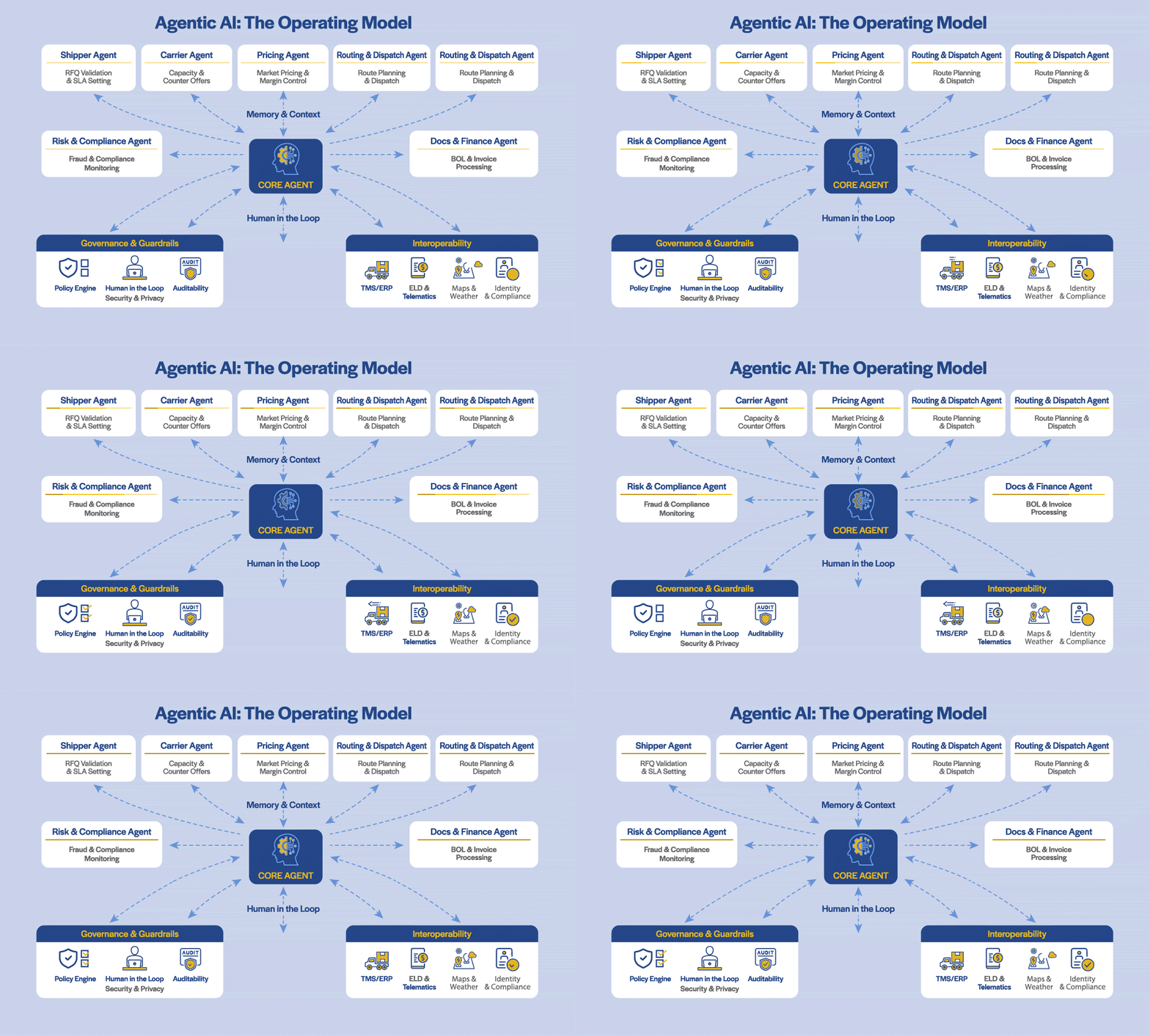
    Agentic AI is creating a new operating model for freight marketplaces. Autonomous software agents can continuously evaluate capacity, rates, carrier performance, service levels, compliance requirements, weather, traffic, and other real-time signals to make and execute decisions within defined business and risk parameters.

    Unlike traditional digital brokerage, which primarily digitizes existing workflows, agent-driven marketplaces operationalize intent. Shipper, carrier, pricing, routing, risk, and documentation agents can work together to match loads and capacity, negotiate rates, execute contracts, manage dispatch, respond to disruptions, and automate documentation and billing.

    The model also enables more intelligent and transparent decision-making. Agents can continuously optimize multiple objectives, including cost, service reliability, carrier performance, capacity utilization, and carbon intensity, while maintaining an auditable record of decisions and ensuring that actions remain within defined policies.

    Human expertise remains central. A Human-in-the-Loop operating model allows agents to manage high-volume, data-intensive decisions at machine speed while people retain control over strategic decisions, complex exceptions, customer relationships, and situations requiring judgment or empathy.

    For shippers, carriers, brokers, and logistics providers, this can translate into faster matching, improved capacity utilization, more predictable pricing, fewer empty miles, stronger compliance, and greater service reliability. The result is a freight ecosystem that is more responsive, transparent, and efficient.

    The transition requires more than deploying AI agents. Organizations must establish a strong data foundation, integrate transportation and enterprise systems, define governance and risk controls, protect sensitive information, and establish measurable business outcomes. A phased approach allows organizations to build confidence in autonomous decision-making while progressively expanding the scope of agent-driven operations.

    Read our perspective paper to explore how Agentic AI is reshaping freight brokerage and discover a practical approach to building governed, autonomous freight marketplaces that combine machine-speed execution with human judgment.
    Download Perspective Paper


      Contact

      Our experts can help you find the right solutions to meet your needs.

      Get in touch
      Agentic Quality Engineering

      Transforming Quality Engineering in the Autonomous Age

      Move beyond script-driven automation with Agentic AI that enables contextual, autonomous, and continuously learning Quality Engineering across the software lifecycle.


        Modern software systems are becoming increasingly cloud-native, distributed, API-first, and AI-enabled, while release cycles continue to accelerate. Traditional Quality Assurance (QA) automation, built around predictable system behavior and static regression suites, is struggling to keep pace. Despite growing automation coverage, defects continue to reach production because conventional testing often identifies whether something failed—but not whether an entire class of risk was never validated.

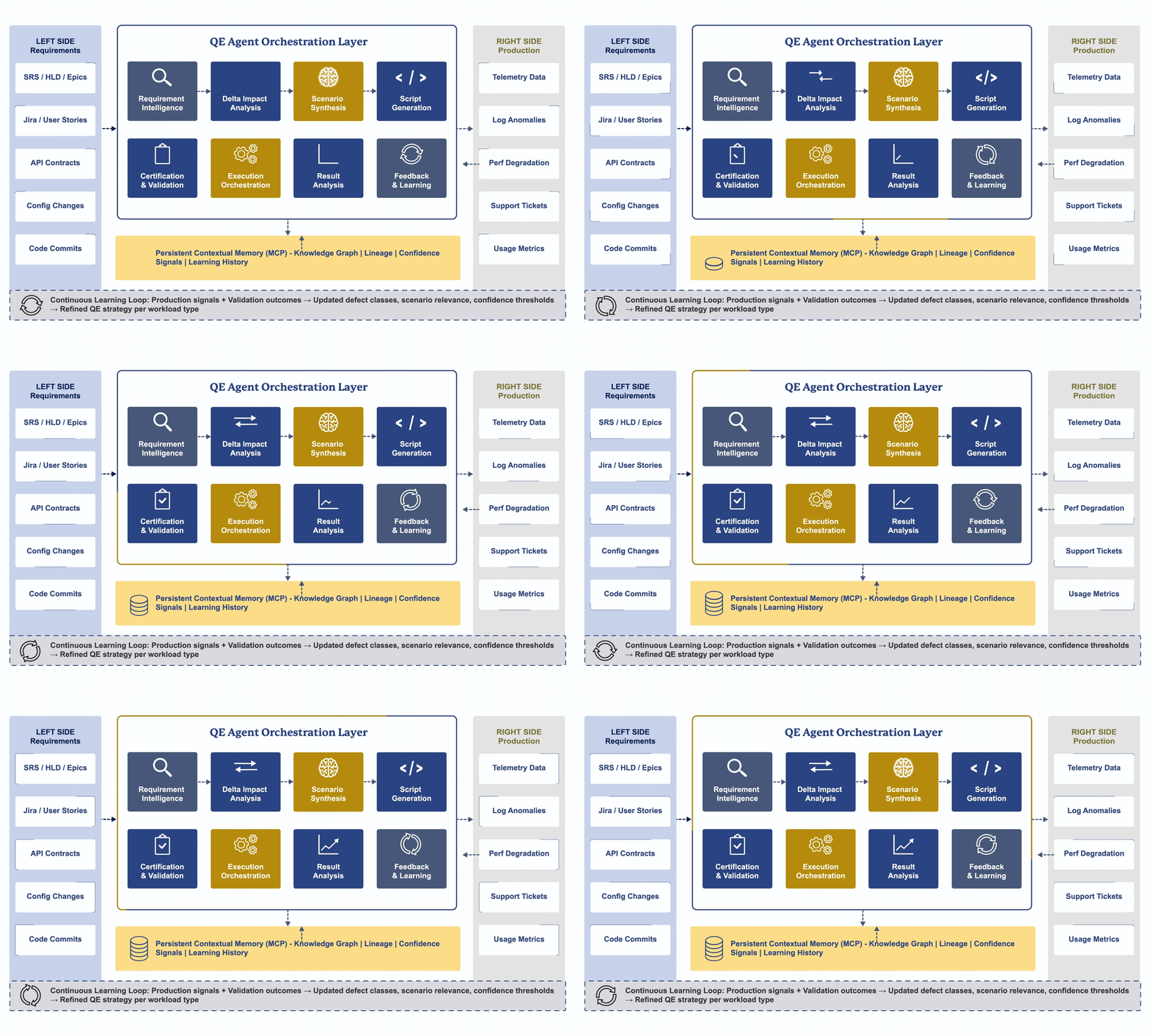
        Agentic AI introduces a new approach to Quality Engineering (QE) by moving beyond deterministic test execution toward contextual, intelligence-driven validation. Specialized AI agents can interpret requirements, analyze change impact, synthesize validation scenarios, orchestrate execution, analyze results, and incorporate production signals to continuously refine validation strategies.

        This shifts QE from a linear requirement-to-test-to-execution model to a recursive lifecycle that learns from both development changes and real-world production behavior. Telemetry, performance trends, log anomalies, support escalations, and recurring production defects can reveal structural coverage gaps and help agents identify emerging vulnerability classes that traditional regression suites may miss.

        An effective Agentic QE model is built on three foundational principles: role-based agentic orchestration, persistent contextual memory, and continuous learning. Together, these enable workload-aware validation across APIs, ETL pipelines, microservices, serverless applications, AI/ML models, and traditional applications while preserving traceability, confidence signals, and human oversight.

        The transformation is not about replacing QE engineers or simply increasing automation. It is about improving the intelligence behind quality decisions—prioritizing validation based on risk and system context, reducing redundant execution, learning from failures, and continuously adapting coverage as software and business requirements evolve.

        Organizations can adopt Agentic QE progressively, beginning with capabilities such as requirement intelligence, semantic change analysis, and risk-based regression optimization, and then incorporating production telemetry, observability, and cross-cycle learning. Over time, this can enable QE systems to become increasingly autonomous while remaining governed by human intent and defined policies.

        Read our perspective paper to explore how Agentic AI can transform Quality Engineering into an adaptive, learning-driven capability that continuously identifies risk, improves validation precision, and helps ensure software works as intended across changing systems and circumstances.

        Download Perspective Paper


          Contact

          Our experts can help you find the right solutions to meet your needs.

          Get in touch
          AI & Digital Roadmap for Mutual Carriers

          The AI & Digital Roadmap for Mutual Carriers

          Modernize infrastructure, automate operations, and adopt AI in phases, without replacing the core systems that run your insurance business.


            Mutual carriers are built on strong governance, member relationships, and operational discipline. But legacy technology, fragmented data, lean IT teams, and rising expectations are making it harder to respond with the speed and insight required today.

            Modernization does not have to mean replacing the systems that already support the business. A phased approach can build digital capabilities around the existing technology landscape, creating value at every stage while establishing the foundation for AI adoption.

            Four Phases to Build a More Intelligent Operating Model

            1. Connect - Create the data and integration foundation by connecting policy, claims, billing, and other core systems through APIs. This reduces manual workarounds and enables information to flow across the organization.
            2. Automate - Orchestrate workflows across connected systems to automate repetitive processes such as claims intake, document processing, and new business processing. Auditable workflow automation reduces administrative effort while improving consistency and speed.
            3. Augment - Introduce Generative AI to support employees with capabilities such as document summarization, claims triage, underwriting support, and customer communication. Human oversight remains central, with AI handling information-intensive tasks while employees retain decision authority.
            4. Elevate - Turn operational data into real-time business intelligence through analytics, dashboards, and reporting. Leadership gains greater visibility into claims performance, underwriting, customer experience, operational resilience, and other business-critical metrics.

            Modernization Without a Big-bang Replacement

            The roadmap demonstrates that core system replacement is not a prerequisite for digital or AI transformation. By connecting existing infrastructure, building workflow layers, and progressively introducing automation, AI, and analytics, mutual carriers can modernize at a manageable pace while preserving the systems and institutional knowledge that underpin the business.

            The result is an operating model that is more connected, efficient, intelligent, and scalable—while remaining governed and aligned with the realities of the insurance business.

            From Technology Investment to Strategic Advantage

            For mutual carriers, modernization is not simply about adopting new technology. It is about creating a digital foundation to respond faster to market demands, strengthen operational resilience, improve employee productivity, and make better-informed decisions.

            Learn how a deliberate, phased roadmap enables carriers to move from fragmented systems and manual processes toward AI-enabled operations that build capabilities today that can support long-term competitive advantage.

            Download Perspective Paper


              Contact

              Our experts can help you find the right solutions to meet your needs.

              Get in touch
              Evolution of Hybrid DLT Architecture

              The Evolution of Hybrid DLT: From Permissioned Ledgers to Public Networks

              Discover how hybrid distributed ledger architecture enables financial institutions to balance privacy, compliance, interoperability, and liquidity by combining the strengths of permissioned and public blockchain networks.


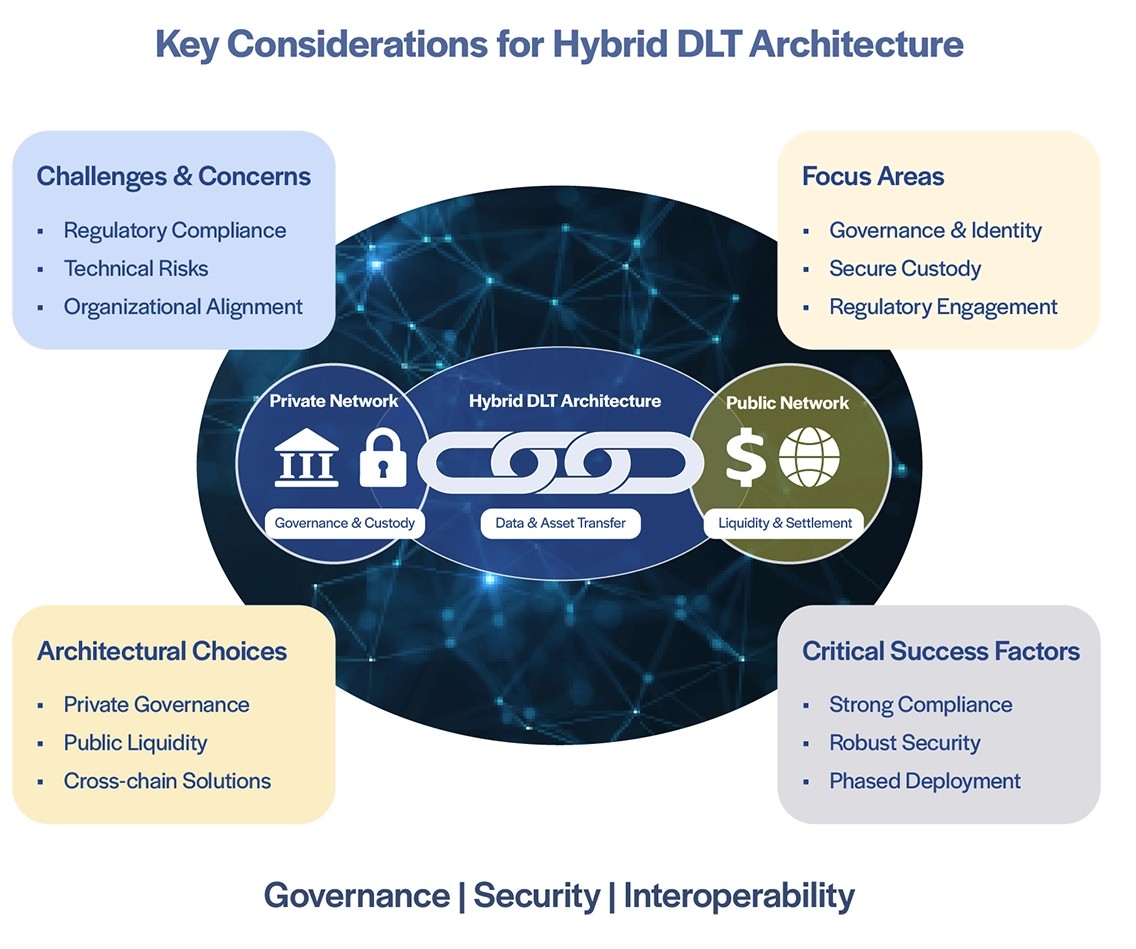
                Financial institutions are accelerating their digital asset and blockchain initiatives but choosing between public and private distributed ledger technologies (DLTs) remains a significant challenge. While public networks offer transparency, interoperability, and access to global liquidity, they often fall short of institutional requirements for privacy, governance, and regulatory compliance. Permissioned DLTs address these concerns but can limit interoperability and market reach.

                Hybrid DLT architecture is emerging as the next stage in distributed ledger evolution by combining the strengths of both models. Sensitive business processes, governance, and regulatory controls remain within permissioned environments, while public blockchain networks enable secure settlement, broader market access, tokenized asset distribution, and programmable financial services. This approach allows organizations to unlock innovation without compromising security or compliance.

                Successfully implementing a hybrid architecture requires more than connecting two networks. Organizations must carefully address governance, identity management, interoperability, cross-chain communication, custody, regulatory alignment, cybersecurity, and enterprise integration. Architectural decisions around asset lifecycle management, smart contracts, cross-chain bridges, and compliance frameworks play a critical role in ensuring secure and scalable deployments.

                Leading financial institutions are already demonstrating how hybrid DLT can support tokenized assets, improve operational efficiency, expand liquidity, and bridge traditional finance with decentralized finance. As regulatory frameworks continue to mature, hybrid architectures are expected to become the preferred foundation for enterprise blockchain adoption.

                Read our perspective paper to explore the evolution of hybrid DLT, understand the key architectural considerations for successful implementation, and learn how financial institutions can build secure, compliant, and future-ready digital asset ecosystems.

                Download Perspective Paper


                  Contact

                  Our experts can help you find the right solutions to meet your needs.

                  Get in touch
                  Agentic AI Framework Operational Risk Commercial Corporate Banking

                  Agentic AI Reduces Risk in Commercial Banking

                  Strengthen operational resilience by embedding AI-driven intelligence, governance, and human oversight into commercial and corporate banking workflows.


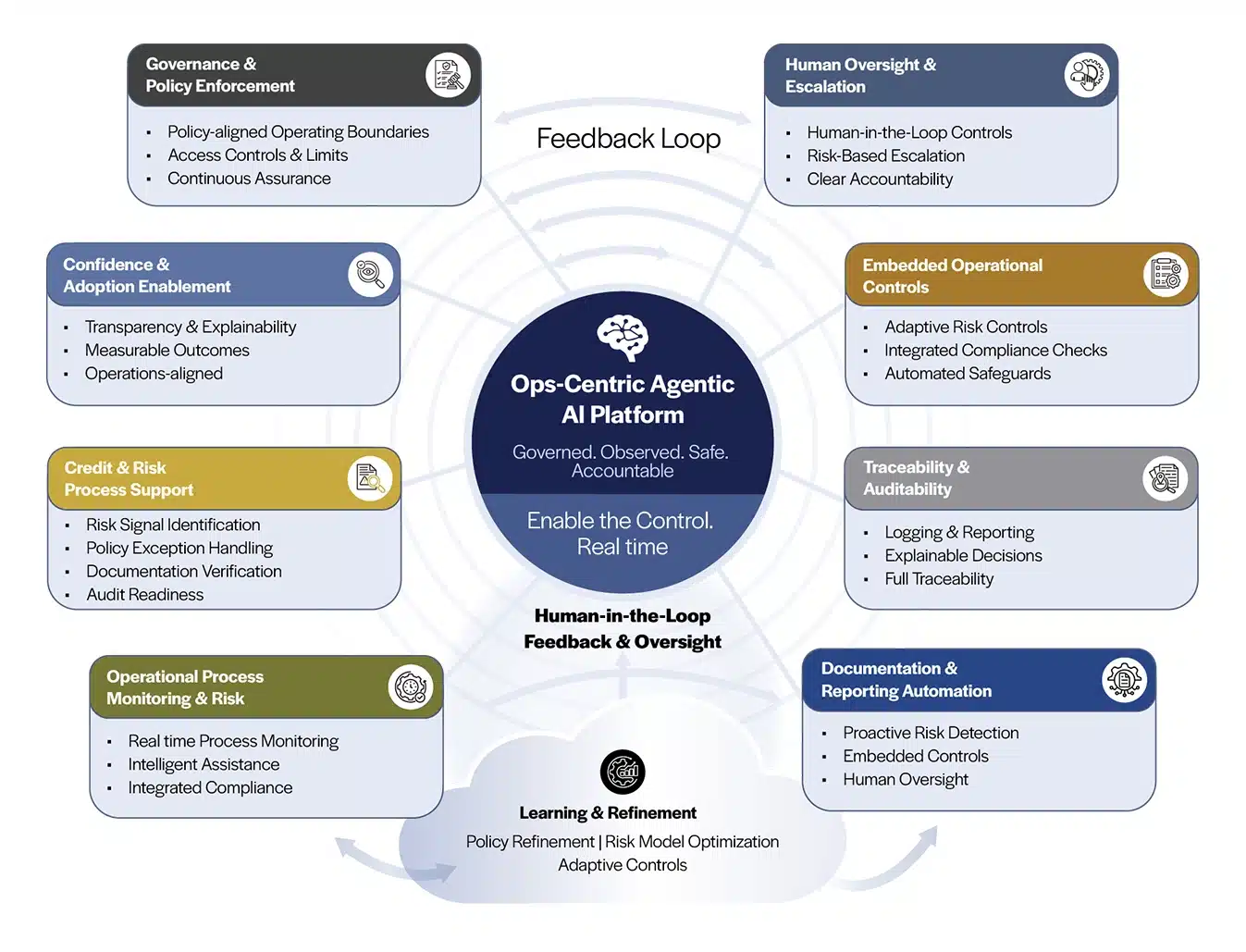
                    An Agentic AI framework introduces intelligent AI agents that continuously monitor operational workflows, detect anomalies, recommend policy-aligned actions, and support decision-making within clearly defined governance boundaries. By combining contextual intelligence with human oversight, banks can improve operational efficiency, strengthen risk management, and maintain transparency, accountability, and regulatory confidence.

                    The framework also enables organizations to capture and institutionalize expert knowledge through a Human-in-the-Loop (HITL) approach. As business and risk professionals review exceptions, interpret policies, and make critical decisions, the platform continuously learns from these interactions. This evolving decision intelligence improves the accuracy, consistency, and policy alignment of future recommendations while ensuring that high-impact decisions remain under human oversight.

                    From operational process monitoring and credit risk support to documentation automation and loan servicing, Agentic AI enables commercial and corporate banks to embed intelligence directly into operational workflows. The result is faster decision-making, improved compliance, enhanced operational efficiency, and greater organizational resilience.

                    Read our perspective paper to discover how an Agentic AI framework helps commercial and corporate banks transition from reactive operational risk management to proactive, AI-powered operational intelligence.

                    Download Perspective Paper


                      Contact

                      Our experts can help you find the right solutions to meet your needs.

                      Get in touch

                      Future ready enterprise payment management system

                      EdTech

                      Future-ready enterprise payment management system

                      Consolidating and standardizing digital payment services to one configurable system lowers costs, enhances service, and enables future e-commerce platform integrations.

                      Client
                      An educational testing and assessment organization
                      Goal
                      To streamline external gateway and acquirer services into a single system to reduce costs, boost service and enable wider payments and e-commerce integration
                      Tools and Technologies
                      Angular JS, PeopleSoft T&L, Vertex Tax Cloud, Chase Payment Tech, PayPal, PostgreSQL
                      Business Challenge

                      The client needed to standardize all credit card and e-payment processes by replacing custom-developed and externally hosted gateways with a merchant-configurable system. The aim was to consolidate gateway and acquirer services under a single vendor to reduce costs, improve service levels, and enable future integration with SaaS or open-source e-commerce solutions.

                      Solution
                      • Created a centralized set of payment collection and processing pages for all e-commerce applications
                      • Ensured PCI compliance at an enterprise level
                      • Integrated and streamlined system reconciliation processes
                      • Implemented robust logging, error handling, and real-time status updates for transactions
                      • Deployed a post back system to capture responses, validate outcomes, update registration statuses, and send error reports via email
                      • Designed the system for future integration with SaaS or open-source e-commerce platforms
                      Outcomes
                      • Reduced costs by eliminating external payment gateway hosting and development fees
                      • Delivered updated and user-friendly validation messages
                      • Enabled future API development for a fully functional service/connection
                      Contact

                      Our experts can help you find the right solutions to meet your needs.

                      Get in touch
                      Explore the world with Iris. Follow us on social media today.

                      New operations system elevates test monitoring and metrics

                      EdTech

                      New operations system elevates test monitoring and metrics

                      Installation of business operations system to proactively monitor test pipelines, assess the potential impacts of disruptions, and provide key data insights.

                      Client
                      An educational testing and assessment organization
                      Goal
                      To develop a system that monitors business operations and provides key metrics to assess the impact of pipeline disruptions
                      Tools and Technologies
                      AWS API Gateway, AWS Lambda, AWS DynamoDB, AWS Kinesis, SQS Queue, AWS Redshift, AWS Quick Sight, MuleSoft, ServiceNow
                      Business Challenge

                      The client required a system to monitor the operations pipeline and provide a high-level overview of critical data and metrics related to test delivery and assessment. The solution needed to track registration and scoring results while also helping evaluate the potential business and financial impact of outages or disruptions.

                      Solution
                      • Developed a Business Operations Support System (BOSS) with executive and operational dashboards
                      • Enabled timely and accurate tracking of registration and scoring results for reporting
                      • Proactively monitored the operations pipeline for SLA and OLA compliance, with alerts for exceptions
                      • Built an operational platform to support multiple programs and act as a centralized data repository
                      Outcomes
                      • Enhanced visibility into monitoring across individual programs and domains
                      • Established the foundation for analytics, machine learning, automation, and intelligent forecasting in internal assessments
                      • Provided actionable inputs for evaluating the business and financial impact of disruptions
                      Contact

                      Our experts can help you find the right solutions to meet your needs.

                      Get in touch
                      Explore the world with Iris. Follow us on social media today.

                      Facilitating data-driven analytics and decision support

                      EdTech

                      Facilitating data-driven analytics and decision support

                      Creating a Data Lakehouse as a single source of truth with a multi-year strategy to derive insights, identify gaps, and enable fact-based decisions.

                      Client
                      An educational testing and assessment organization
                      Goal
                      To create a single data source that gives market insights, identifies gaps and facilitates a multi-year data-driven strategy
                      Tools and Technologies
                      Redshift, AWS Glue, AWS Kinesis, Apache Spark, AWS Athena, AWS Lake Formation
                      Business Challenge

                      The client managed vast amounts of data from multiple sources to extract market insights However, duplication across approximately 300 applications hampered analytics and adaptability.  The goal was to eliminate duplication, identify gaps, and create a single source of data that could be leveraged for efficient, data-driven decision-making.

                      Solution
                      • Built a centralized Data Lake and Data Lakehouse as the single source of data
                      • Facilitated seamless data ingestion
                      • Created a single version of data and DataOps processes
                      • Streamlined governance through retirement of duplicate and mirrored databases
                      • Outlined a multi-year data strategy with clear foundational steps for scalability
                      Outcomes
                      • Enabled analysis and advanced analytics using a centralized data lake
                      • Transformed decision making into a data-driven process
                      Contact

                      Our experts can help you find the right solutions to meet your needs.

                      Get in touch
                      Explore the world with Iris. Follow us on social media today.

                      Migrating multiple databases to one streamlined source

                      EdTech

                      Migrating multiple databases to one streamlined source

                      Developing an architecture for data migration from several databases to a single, streamlined source with automated workflows, improved data analytics, execution of complex business rules, and cost savings.

                      Client
                      Major educational testing and assessment organization
                      Goal
                      Enable data migration from multiple sources to a streamlined source with automated workflows and improved data analytics
                      Tools and Technologies
                      AWS Glue, Redshift, Power BI, Oracle, MS SQL Server, MS SharePoint
                      Business Challenge

                      The client used a limited number of applications to source data from multiple types of databases. The outdated system slowed responses to critical requests. It also faced challenges in executing complex business rules. Owing to the lack of a centralized data warehouse, its data analytics could not deliver meaningful insights. Maintenance costs were also high.

                      The goal was to streamline the number of data sources, create a single store for data analytics, and reduce overall costs.

                      Solution
                      • Developed a customizable ETL architecture to pull data from any type of data source
                      • Created fully automated workflows using AWS Glue to transfer data between Stage, ODS and DWH instances
                      • Built a single source of information for data analytics
                      • Developed data analytics dashboards in Power BI
                      • Enabled system to perform complex business rules on the fly by integrating AWS Glue with stored procedures
                      Outcomes
                      • Optimized and consolidated multiple servers into three or fewer
                      • Reduced risk involved in maintenance of unsupported and dated database servers
                      • Improved data processing and data transfer by automating workflows
                      • Enhanced quality by using a single source of information for data analytics and applications
                      Contact

                      Our experts can help you find the right solutions to meet your needs.

                      Get in touch
                      Explore the world with Iris. Follow us on social media today.

                      Reuters – The Future of Insurance 2026

                      Reuters – The Future of Insurance 2026

                      Reuters – The Future of Insurance

                      Connect with Venkat Laksh, our Head of Insurance IT Sales, at the 2026 FOI forum to learn how insurers are fusing advanced, AI-driven technologies and other enterprise growth areas.

                      Reuters Events hosts this year’s Future of Insurance (FOI) forum on June 25-26, 2026, at the Marriott Marquis Hotel in Chicago, Illinois. FOI is a premier North American industry event where more than 500 insurance leaders come together to discuss and align key topic areas of technology, products, customers and risk. The primary themes of this year’s FOI sessions are turning strategy into growth, building the digital backbone, elevating customer experience, and ensuring risk readiness.

                      Iris provides Insurtech services to leading insurers, in property, casualty, specialty, life and annuity, and other sectors, that result in measurable positive outcomes in these areas. Venkat Laksh, our Head of Insurance IT Sales, is attending FOI 2026 to share Iris client success stories and the value derived from our advanced AI-powered capabilities, domain expertise, and collaborative, client-centric approach. Learn from Venkat how partnering with Iris and applying our solutions in Agentic and Generative AI/ML, Application Engineering and Modernization, Cloud and Data Engineering, can advance the digital transformation and strategic growth goals of your enterprise.

                      You also can contact our InsurTech team, including Abhineet Jha, Head of Insurance IT Services, and Client Partners Glenn DeGeorge, Parijat Sharma, and Vaibhav Brajesh and Delivery Partner, Mayank Khanna, to discuss your technology objectives.

                      Learn more about our Insurance Technology Services and Generative AI Experience.

                      Contact

                      Our experts can help you find the right solutions to meet your needs.

                      Get in touch