
Transforming Quality Engineering in the Autonomous Age
Move beyond script-driven automation with Agentic AI that enables contextual, autonomous, and continuously learning Quality Engineering across the software lifecycle.

Modern software systems are becoming increasingly cloud-native, distributed, API-first, and AI-enabled, while release cycles continue to accelerate. Traditional Quality Assurance (QA) automation, built around predictable system behavior and static regression suites, is struggling to keep pace. Despite growing automation coverage, defects continue to reach production because conventional testing often identifies whether something failed—but not whether an entire class of risk was never validated.
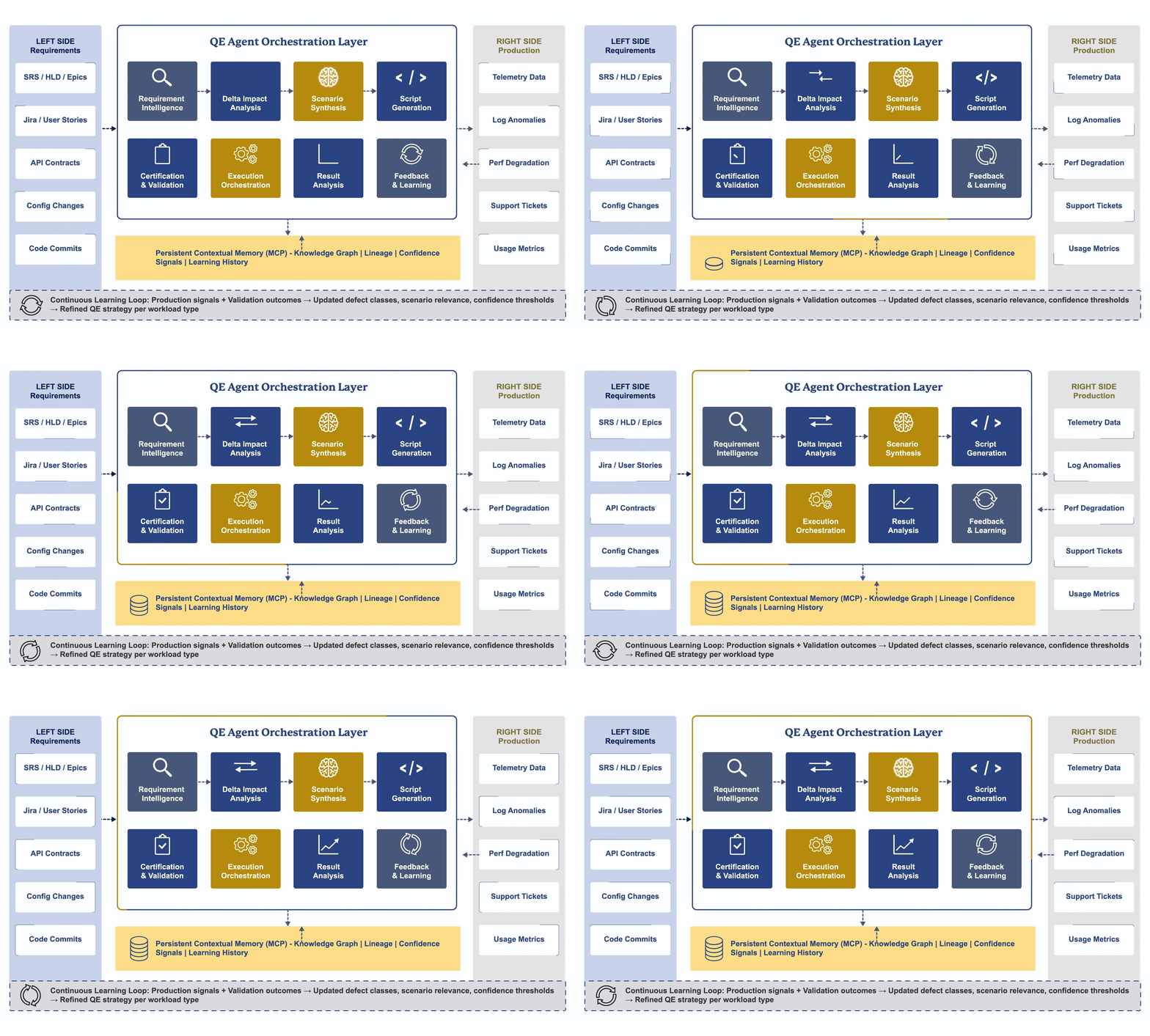
Agentic AI introduces a new approach to Quality Engineering (QE) by moving beyond deterministic test execution toward contextual, intelligence-driven validation. Specialized AI agents can interpret requirements, analyze change impact, synthesize validation scenarios, orchestrate execution, analyze results, and incorporate production signals to continuously refine validation strategies.
This shifts QE from a linear requirement-to-test-to-execution model to a recursive lifecycle that learns from both development changes and real-world production behavior. Telemetry, performance trends, log anomalies, support escalations, and recurring production defects can reveal structural coverage gaps and help agents identify emerging vulnerability classes that traditional regression suites may miss.
An effective Agentic QE model is built on three foundational principles: role-based agentic orchestration, persistent contextual memory, and continuous learning. Together, these enable workload-aware validation across APIs, ETL pipelines, microservices, serverless applications, AI/ML models, and traditional applications while preserving traceability, confidence signals, and human oversight.
The transformation is not about replacing QE engineers or simply increasing automation. It is about improving the intelligence behind quality decisions—prioritizing validation based on risk and system context, reducing redundant execution, learning from failures, and continuously adapting coverage as software and business requirements evolve.
Organizations can adopt Agentic QE progressively, beginning with capabilities such as requirement intelligence, semantic change analysis, and risk-based regression optimization, and then incorporating production telemetry, observability, and cross-cycle learning. Over time, this can enable QE systems to become increasingly autonomous while remaining governed by human intent and defined policies.
Read our perspective paper to explore how Agentic AI can transform Quality Engineering into an adaptive, learning-driven capability that continuously identifies risk, improves validation precision, and helps ensure software works as intended across changing systems and circumstances.