

Payments Canada Summit 2024
Toronto-based banking, financial services, and payments technology experts, Subramanian Viswanathan and Suneela Katikala, are attending this year’s Summit.

As a key provider of technology services to leading Canadian and global banks, including those operating in the retail banking and payments sector, Iris will participate in the Payments Canada Summit at Beanfield Centre in Toronto, Ontario, May 29-31, 2024. This forum is considered Canada’s premier payments event, bringing together monetary, financial, regulatory, and technology leaders for presentations, networking, and idea-sharing relating to the fast-paced and continually-evolving world of payments.
Connect with two of Iris’ banking and financial services experts at the Summit to discuss digital transformation and payment system modernization: Subramanian Viswanathan, Associate Vice President, Financial Services Practice, and Suneela Katikala, Senior Client Partner, Financial Services.
Learn how banks and associated entities apply Iris’ deep domain knowledge and experience and advanced technology solutions - in AI / ML, Application Development, Automation, Cloud, DevOps, Data Science, Enterprise Analytics, Integrations, and Quality Engineering - to enhance security, scalability, cost-efficiency, and compliance in the myriad platforms, processes and systems supporting domestic and international payments transactions – involving clearing, settlement, currency, etc. Iris is PCIDSS 4.0-certified to ensure robust cyber security and compliance for our clients involved in payment card processing or that store, process, or transmit cardholder data and/or sensitive authentication data.
Contact our team and obtain more information about future-ready Iris Software Banking and Financial Services. You can also read our Perspective Paper on the state of Central Bank Digital Currency.
Conversational assistant boosts AML product assurance


Gen AI powered responses improve the turnaround time to provide technical support for recurring issues, resulting in a highly efficient product assurance process.

Client
A large global bank
Goal
Improve turnaround time to provide technical support for the application support and global product assurance teams
Tools and Technologies
React, Sentence–Bidirectional Encoder Representations from Transformers (S-BERT), Facebook AI Similarity Search (FAISS), and Llama-2-7B-chat
Business Challenge
The application support and global product assurance teams of a large global bank faced numerous challenges in delivering efficient and timely technical support as they had to manually identify solutions to recurring problems within the Known Error Database (KEDB), comprised of documents in various formats. With the high volume of support requests and limited availability of teams across multiple time zones, a large backlog of unresolved issues developed, leading to higher support costs.

Solution
Our team developed a conversational assistant using Gen AI by:
- Building an interactive customized React-based front-end
- Ringfencing a corpus of problems and solutions documented in the KEDB
- Parsing, formatting and extracting text chunks from source documents and creating vector embeddings using Sentence–Bidirectional Encoder Representations from Transformers (S-BERT)
- Storing these in a Facebook AI Similarity Search (FAISS) vector database
- Leveraging a local Large Language Model (Llama-2-7B-chat) to generate summarized responses

Outcomes
The responses generated using Llama-2-7B LLM were impressive and significantly reduced overall effort. Future enhancements to the assistant would involve:
- Creating support tickets based on information collected from users
- Categorizing tickets based on the nature of the problem
- Automating repetitive tasks such as access requests / data volume enquiries / dashboard updates
- Auto-triaging support requests by asking users a series of questions to determine the severity and urgency of the problem

Our experts can help you find the right solutions to meet your needs.
Explore the world with Iris. Follow us on social media today.
Automated financial analysis reduces manual effort


Analysts in a large North American bank's commercial lending and credit risk operations can source intelligent information across multiple documents.
Client
Commerical lending and credit risk units of large North American bank
Goal
Automated retrieval of information from multiple financial statements enabling data-driven insights and decision-making
Tools and Technologies
OpenAI API (GPT-3.5 Turbo), LlamaIndex, LangChain, PDF Reader
Business Challenge
A leading North American bank had large commercial lending and credit risk units. Analysts in those units typically refer to numerous sections in a financial statement, including balance sheets, cash flows, and income statements, supplemented by footnotes and leadership commentaries, to extract decision-making insights. Switching between multiple pages of different documents took a lot of work, making the analysis extra difficult.
Solution
Many tasks were automated using Gen AI tools. Our steps:
- Ingest multiple URLs of financial statements
- Convert these to text using the PDF Reader library
- Build vector indices using LlamaIndex
- Create text segments and corresponding vector embeddings using OpenAI’s API for storage in a multimodal vector database e.g., Deep Lake
- Compose graphs of keyword indices for vector stores to combine data across documents
- Break down complex queries into multiple searchable parts using LlamaIndex’s DecomposeQueryTransform library
Outcomes
The solution delivered impressive results in financial analysis, notably reducing manual efforts when multiple documents were involved. Since the approach is still largely linguistic in nature, considerable Prompt engineering may be required to generate accurate responses.
Response limitations due to the lack of semantic awareness in Large Language Models (LLMs) may stir considerations about the usage of qualifying information in queries.
Our experts can help you find the right solutions to meet your needs.
Explore the world with Iris. Follow us on social media today.
Next generation chatbot eases data access


Gen AI tools help users of retail brokerage trading platform obtain information related to specific needs and complex queries.
Client
Large U.S.-based Brokerage and Wealth Management Firm
Goal
Enable a large number of users to readily access summarized information contained in voluminous documents
Tools and Technologies
Google Dialogflow ES, Pinecone, Llamaindex, OpenAI API (GPT-3.5 Turbo)
Business Challenge
A large U.S.-based brokerage and wealth management firm has a large number of users for its retail trading platform that offers sophisticated trading capabilities. Although extensive information was documented in hundreds of pages of product and process manuals, it was difficult for users to access and understand information related to their specific needs (e.g., How is margin calculated? or What are Rolling Strategies? or Explain Beta Weighting).
Solution
Our Gen AI solution encompassed:
- Building a user-friendly interactive chatbot using Dialogflow in Google Cloud
- Ringfencing a knowledge corpus comprising specific documents to be searched against and summarized (e.g., 200-page product manual, website FAQ content)
- Using a vector database to store vectors from the corpus and extract relevant context for user queries
- Interfacing the vector database with OpenAI API to analyze vector-matched contexts and generate summarized responses
Outcomes
The OpenAI GPT-3.5 turbo LLM (170 bn parameters) delivered impressive linguistic search and summarization capabilities in dealing with information requests. Prompt engineering and training are crucial to secure those outcomes.
In the case of a rich domain such as a trading platform, users may expect additional capabilities, such as:
- API integration to support requests requiring retrieval of account/user specific information, and
- Augmentation of linguistic approaches with semantics to deliver enhanced capabilities.
Our experts can help you find the right solutions to meet your needs.
Explore the world with Iris. Follow us on social media today.

The state of Central Bank Digital Currency
Innovations in digital currencies could redefine the concept of money and transform payments and banking systems.
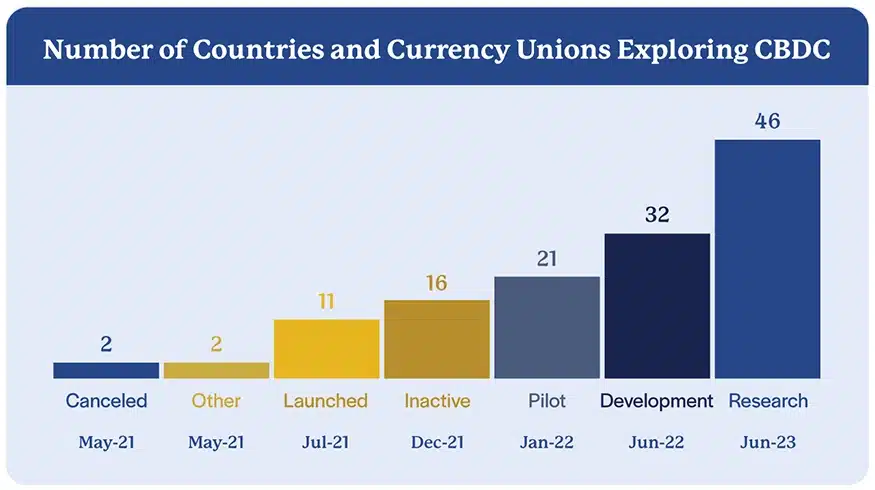
Central banking institutions have emerged as key players in the world of banking and money. They play a pivotal role in shaping economic and monetary policies, maintaining financial system stability, and overseeing currency issuance. A manifestation of the evolving interplay between central banks, money, and the forces that shape financial systems is the advent of Central Bank Digital Currency (CBDC). Many drivers have led central banks to explore CBDC: declining cash payments, the rise of digital payments and alternative currencies, and disruptive forces in the form of fin-tech innovations that continually reshape the payment landscape.
Central banks are receptive towards recent technological advances and well-suited to the digital currency experiment, leveraging their inherent role of upholding the well-being of the monetary framework to innovate and facilitate a trustworthy and efficient monetary system.
In 2023, 130 countries, representing 98% of global GDP, are known to be exploring a CBDC solution. Sixty-four of them are in an advanced phase of exploration (development, pilot, or launch), focused on lower costs for consumers and merchants, offline payments, robust security, and a higher level of privacy and transparency. Over 70% of the countries are evaluating digital ledger technology (DLT)-based solutions.
While still at a very nascent stage in terms of overall adoption for CBDC, the future of currency promises to be increasingly digital, supported by various innovations and maturation. CBDC has the potential to bring about a paradigm shift, particularly in the financial industry, redefining the way in which money, as we know it, exchanges hands.
Read our perspective paper to learn more about CBDCs – the rationale for their existence, the factors driving their implementation, potential ramifications for the financial landscape, and challenges associated with their adoption.
Custom analytics enable faster business decisions


Optimized data and on-demand analytics deliver faster business insights and better user experience for asset management firm.
Client
U.S.-based asset management company
Goal
Streamline and improve data and analytics capabilities for enhanced user experiences
Technology Tools
Java, React JS, MS SQL Server, Spring Boot, GitHub, Jenkins
Business Challenge
The client captures voluminous data from multiple internal and external sources. The absence of quick, on-demand capabilities for business users was inefficient in generating customized portfolio analytics on attributes such as average quality, yield to maturity, average coupon, etc.
The client teams were spending enormous amounts of manual effort and elapsed time (approximately 12-15 hours) to respond to requests for proposals from their respective clients.
Solution
Iris implemented a data acquisition and analytics system with pre-processing capabilities for grouping, classifying, and handling historical data.
A data dictionary was established for key concepts, such as asset classes and industry classifications, enabling end users to access data for analytical computation. The analytics engine was refactored, optimized, and integrated into the streamlined investment performance data infrastructure.
The team developed an interactive self-service capability, allowing business users to track data availability, perform advanced searches, generate custom analytics, visualize information, and utilize the insights for decision-making.
Outcomes
The solution brought several benefits to the client, including:
- Simplified data access to generate custom analytics for end users
- Eliminated manual processing and the need for complex queries
- Enhanced the stakeholder experience
- Reduced response time to client RFPs by over 50%
Our experts can help you find the right solutions to meet your needs.
Explore the world with Iris. Follow us on social media today.
Next-gen platform reliability engineering for Blockchain-DLT


Banking & Financial Services
Next-gen platform reliability engineering for Blockchain-DLT
Reliability engineering helps a digital financial services client smoothly migrate its legacy Blockchain-DLT (Digital Ledger Technology) platform and gain advanced automation coverage and patch delivery efficiencies.
Client
A leading digital financial services company
Goal
Blockchain- DLT platform assurance with improved automation coverage
Tools and Technologies
Amazon Elastic Kubernetes Service (EKS), Azure Kubernetes Services (AKS), Docker, Terraform, Helm Charts, Microservices, Kotlin, Xray
Business Challenge
The client's legacy DLT platform did not support cloud capabilities with the Blockchain-DLT tech stack. The non-GUI (Graphic User Interface) and CLI (Command Line Interface)-based platform lacked the microservices architecture and cluster resilience.
The REST (Representational State Transfer) APIs-based platform did not support platform assurance validation at the backend. Automation coverage for legacy and newer versions of the products was very low. Support for delivery patches was insufficient, impacting the delivery of multiple versions of R3 products each month.
Solution
Iris developed multiple CorDapps to support automation around DLT-platform functionalities and enhanced the CLI-based & cluster utilities in the existing R3 automation framework.
The team implemented the test case management tool Xray to improve test automation coverage for legacy and newer versions of the Corda platform, enabling smooth and frequent patch deliveries every month.
The quality engineering process was streamlined for the team's Kanban board by modifying the workflows. Iris also introduced the ability to execute a testing suite that could run on a daily or as-needed basis for AKS, EKS, and Local MAC/ Windows/ Linux cluster environments.
Outcomes
The Blockchain-DLT reliability assurance solution enabled the client to attain:
- Improved automation coverage of the DLT platform with 900 test cases with a pass rate of 96% in daily runs
- Compatibility across AWS-EKS, Azure-AKS, Mac, Windows, Linux, and local clusters
- Increased efficiency in deliverables with an annual $35K savings in the test case management area
Our experts can help you find the right solutions to meet your needs.
Explore the world with Iris. Follow us on social media today.
Big Data platform improves global AML compliance


A multinational bank leverages big data platform to improve Anti Money Laundering (AML) compliance and protect global clients and franchises from financial crimes.
Client
A leading global bank with operations in over 100 countries
Goal
Address data quality and cost challenges of legacy AML application infrastructure
Tools and Technologies
Hadoop, Hive, Talend, Kafka, Spark, ETL
Business Challenge
The client’s legacy AML application infrastructure was leading to data acquisition, quality assurance, data processing, AML rules management and reporting challenges.
High data volume and rules-based algorithms were generating high numbers of false positives. Multiple instances of legacy vendor platforms were also adding to cost and complexity.
Solution
Iris developed and implemented multiple AML Trade Surveillance applications and Big Data capabilities. The team designed a centralized data hub with Cloudera Hadoop for AML business processes and migrated application data to the big data analytical platform in the client’s private cloud. Switching from a rule-based approach to algorithmic analytical models, we incorporated a data lake with logical layers and developed a metadata-driven data quality monitoring solution.
We enabled the support for AML model development, execution and testing/validation, and integration with case management. Our data experts also deployed a custom metadata management tool and UI to manage data quality. Data visualization and dashboards were implemented for alerts, monitoring performance, and tracking money laundering activities.
Outcomes
The implemented solution delivered tangible outcomes, including:
- Centralized data hub capable of handling 100+ PB of data and ~5,000 users across 18 regional hubs for several countries
- Ingestion of 30+ million transactions per day from different sources
- Greater insights with scanning of 1.5+ Billion transactions every month
- False positives reduced by over 30%
- AML data storage cost reduced to <10 cents per GB per year
- Extended support to multiple countries and business lines across six global regions; legacy instances reduced from 30+ to <10
Our experts can help you find the right solutions to meet your needs.
Explore the world with Iris. Follow us on social media today.
Investment warehouse enhances communications


Account management and marketing teams of an investment bank acquired improved multi-channel client communications and portfolio management capabilities with a new data infrastructure and a single source of truth.
Client
A U.S.-based investment bank
Goal
Improve data collation and information quality for enhanced marketing and client reporting functions
Tools and Technologies
Composite C1, Oracle DB, PostgreSQL, Vermilion Reporting Suite, Python, MS SQL Server, React.js
Business Challenge
The client’s existing investment data structure lacked a single source of truth for investment and performance data. The account management and marketing teams were making significant manual efforts to track portfolio performance, identify opportunities and ensure accurate client reporting. The time-consuming and manual processes of generating marketing exhibits and client reports were highly error-prone.
Solution
Iris implemented a comprehensive investment data infrastructure for a single source of truth and improved reporting capabilities for marketing content and client report generation.
An automated Quality Assurance process was instituted to validate the information in critical marketing materials, such as fact sheets, snapshots, sales kits, and flyers, against the respective data source systems.
Retail and institutional portals were developed to provide a consolidated view of portfolios, with the ability to drill down to underlying assets, AUM (Assets Under Management) trends, incentives, commissions, and active opportunities.
Outcomes
The new data infrastructure delivered a holistic, on-demand view of investment details, including performance characteristics, breakdowns, attributions, and holdings, to the client's marketing team and account managers with:
- ~95% reduction in performance data and exhibit information discrepancies
- ~60% improvement in operational efficiency in core marketing and client reporting functions
Our experts can help you find the right solutions to meet your needs.
Explore the world with Iris. Follow us on social media today.
Brokerage platform transformation improves UX


A monolithic registered investment advisor (RIA) platform transformed into microservices helps a leading brokerage firm achieve enhanced operations and user experience.
Client
A leading U.S. brokerage firm with $1+ trillion in assets and serving 6,000+ RIAs
Goal
Resolve online platform accessibility, functionality and timeliness issues
Tools and Technologies
Angular 9, Jenkins, Pivotal Cloud Foundry, Oracle, Kubernetes, Spring, Docker
Business Challenge
Client’s existing brokerage platform supporting over 6,000 Registered Investment Advisors (RIAs) and containing information about assets valued at more than $1 trillion had accessibility issues. The high cost of owning and maintaining outdated technologies and time-to-market for new features were adding to the business challenges.
Solution
Iris transitioned the client’s monolith applications to microservices to transform the RIA platform. An open-source, cloud technical stack was leveraged to develop a single-page, micro-UI-based application. BFF (Backend for Frontend) design was applied, and Angular 9 was used to achieve superior compatibility on mobile devices.
Widgets were introduced to enable seamless transitions within third-party applications. Consolidated user views were created to track assets and their performance for a unified experience for the RIAs.
Outcomes
The RIA platform transformation enabled the client to achieve significant functional enhancements, including:
- Fully functional mobile views
- 100+ integrated third-party applications
- Instant and seamless access to client accounts
- Downtime for hot deployments of fixes brought to zero
- Technical debt decreased by 45%
- Release timelines shortened by 80%
- Issue resolution time reduced by 90%
Our experts can help you find the right solutions to meet your needs.
Explore the world with Iris. Follow us on social media today.
