Celebrating 35 Years of Iris icon Explore the Journey

×
API platform migration increases capacity by 6x

Platform migration increases API capacity by 6x

Migration of legacy API platform to Apigee and GCP and API productizing led to 6x higher capacity and 70% reduction in support tickets, enhancing business growth and customer satisfaction for a global logistics firm.



    Our client, a leader in truck transportation and logistics services with more than 50,000 customers across 33 countries, had developed customer-facing APIs using earlier generations of API platforms. These APIs connected their transportation management system with several other critical systems such as GPS tracking, warehouse management, and real-time customer portals. Scalability and reliability issues were plaguing the client’s API management system due to the legacy infrastructure and increasing numbers of APIs, leading to poor customer satisfaction and decreased competitiveness.

    The client sought a technology partner who could understand the complex business logic within the existing API structure and execute a seamless migration and modernization that would improve the performance and scalability of the APIs for its customers. A team of Apigee experts at Iris Software addressed the challenges with a comprehensive, customized four-step approach that consisted of:

    1. Outlining the migration strategy to move 18+ APIs to a more robust API Gateway
    2. Automating the migration from the legacy API Gateway to Apigee to ease customer transitions
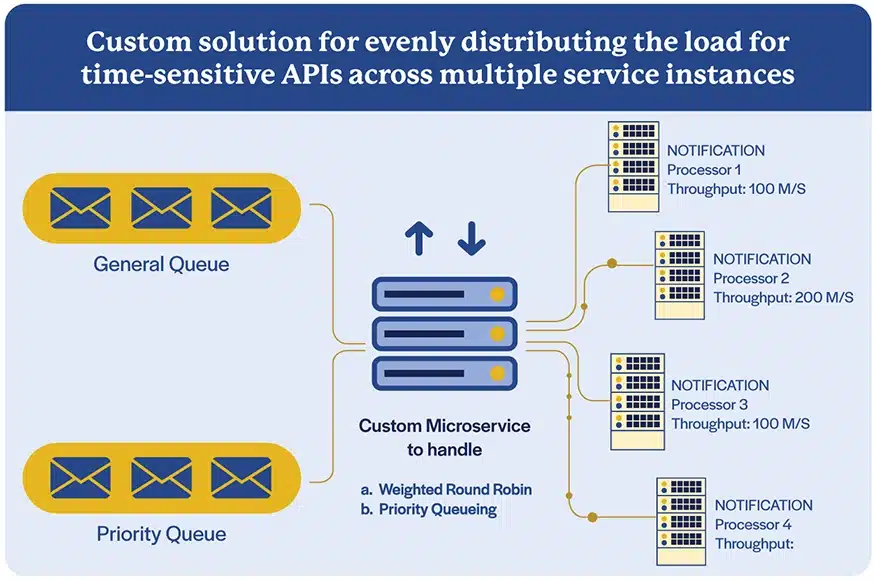
    3. Balancing internal system loads to increase scalability and throughput
    4. Implementing Apigee analytics for improved traceability and faster mitigation of issues

    Iris’ solution provided multi-market, multi-channel and multi-partner integration as well as other positive outcomes for the client:

    • 70% reduction in support tickets related to shipment delays
    • 6x increase in API throughput
    • New revenue streams from the creation of four new API products

    Learn more by downloading the full success story here.

    Download Success Story


      Contact

      Our experts can help you find the right solutions to meet your needs.

      Get in touch
      Succeeding in ML Operations journeys

      Succeeding in ML operations journeys

      As machine learning becomes increasingly prevalent in the business world, more and more enterprises are considering the cloud as a way to scale their machine learning efforts.


        The promise of AI and ML to deliver significant competitive advantages and contribute to the growth of the organization is now well established. Organizations, big and small, are adopting these to drive their strategic business goals.

        However, moving machine learning workloads to cloud has its own challenges. Organizations are realizing that operational and support requirements increase rapidly as data science and modeling teams adopt emerging AI/ML platforms on cloud.

        Machine Learning and Operations, or MLOps for short, is significantly different from traditional software development practices and requires a different way of thinking about how machine learning models are developed, deployed, and maintained. This shift can be difficult for various teams involved in governance, enablement, and support of public cloud-based capabilities that are used to more traditional approaches, and requires a change in culture and mindset.

        The power of AI/ML models and platforms and the potential for deriving significant value from them is accelerating very fast. It is increasingly becoming a critical imperative for firms to adopt these rapidly to ensure they remain competitive. However, successfully adopting these at scale would require the use of public cloud technologies. Public cloud adoption in many industries is still in the early stages, with many internal groups to work with and evolving processes and standards. By establishing clear ownership for MLOps & DataOps and simplifying adoption through the use of templates and automation, firms can overcome these challenges and scale AI/ML on cloud while ensuring overall agility and cost-effectiveness.

        To learn more about the key challenges and our learnings and best practices, download the perspective paper.

        Download Perspective Paper


          Contact

          Our experts can help you find the right solutions to meet your needs.

          Get in touch
          Navigating distributed ledger technologies

          Navigating distributed ledger technologies

          Distributed ledger technology (DLT) strengthens data security, promotes transparency in transactions and can potentially revolutionize industries.


            Today’s enterprises rely heavily on information systems to enable their business processes, which are usually managed and controlled by the respective enterprises. However, there are a lot more multilateral transactions in the modern business value cycle. These span cross-enterprise and require faster, reliable access to the latest, comprehensive information about the transactions to make them more effective and, eventually, lead to better collaboration among enterprises.

            The reality, however, is that with decentralized information systems and each participant managing their version of truth, enterprises end up having an opaque information architecture resulting in information discrepancies, countless reconciliations, unproductive person-hours spent resolving these, increased operational risk, weakened trust, and increased cost.

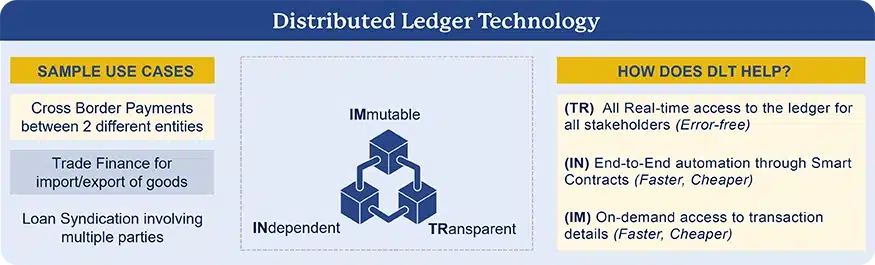
            Decentralization by way of DLT is a step towards addressing these issues, enabling companies to jointly manage, operate and use a platform to maintain a single version of truth across participants and strong cryptography to create trust and immutability, which helps reduce the issues mentioned above. The objective is to deliver tamper-proof data and transparency to all network participants in a consensually-agreed manner.

            Distributed ledger technologies have evolved and matured over the last few years. While it came about with cryptocurrencies, the application of this technology in alternative use cases can benefit enterprises, and adoption of DLT is on the rise across industries.

            This perspective paper addresses the evolution and application of DLT in enterprises, and how it can be further embraced to realize potential across multilateral solutions. To learn more about the pillars and eminent platforms of DLT, key challenges and industry use cases, download the perspective paper. 

            Download Perspective Paper


              Contact

              Our experts can help you find the right solutions to meet your needs.

              Get in touch

              Release automation reduces testing time by 80%

              PROFESSIONAL SERVICES

              Release automation reduces testing time by 80%

              DevOps implementation and release automation improved testing time, product quality, and global reach for a leading multi-level marketing company.

              Client
              A leading multi-level marketing company
              Goal
              Shorten the release cycle and improve product quality
              Tools and Technologies
              Amazon CloudWatch, Elasticsearch, Bitbucket, Jenkins, Amazon ECR, Docker, and Kubernetes
              Business Challenge

              The client's Commercial-off-the-shelf (COTS) applications were built using substandard code branching methods, causing product quality issues. The absence of a release process and a manual integration and deployment process were elongating release cycles. Manual configuration and setup of these applications were also leading to extended downtime. Missing functional, smoke, and regression test cases were adding to the unstable development environment. The database migration process was manual, resulting in delays, data quality issues, and higher costs.

              Solution
              • Code branching and integration strategy for defects / hotfixes in major and minor releases​
              • Single-click application deployment, including environment creation, approval and deployment activities​
              • Global DevOps platform implementation with a launch pad for applications to onboard other countries​
              • Automated configuration and deployment of COTS applications and databases​
              • Automation suite with 90% coverage of smoke and regression test cases​
              • Static and dynamic analysis implementations to ensure code quality and address configuration issues​
              Outcomes

              Automation of release cycles delivered the following benefits to the client:

              • Release cycle shortened from once a month to once per week
              • MTTR reduced by 6 hrs
              • Downtime decreased to <4 hours from 8 hours
              • Product quality and defect leakage improved by 75%
              • Testing time reduced by 80%
              • Reach expanded to global geographies
              • Availability, scalability, and fault tolerance enhanced for microservices-based applications
              Contact

              Our experts can help you find the right solutions to meet your needs.

              Get in touch
              Explore the world with Iris. Follow us on social media today.

              DevOps solution improves scalability by 5x

              LIFE SCIENCES

              Automated app & infra deployment improves scalability

              Automated app and infra deployment with DevOps implementation help a leading medical company launch applications in new geographies, improve time-to-market, and reduce the total cost of ownership.

              Client
              North America-based fertility and genomics company
              Goal
              Expand business reach, reduce time-to-market, and support critical compliance
              Tools and Technologies
              .NET 5, Vue.js, AWS Secrets Manager, AWS Transfer Family, Amazon RDS, Amazon EKS, Amazon Route 53, Amazon CloudFront, Terraform, GitLab
              Business Challenge

              The client wanted to expand its reach to Canada, Europe, and APAC regions to meet the requirements for a 10x increase in their user base. Legacy application infrastructure and code built on the old tech stack, with high technical debt, were slowing down the rollout of new features, making the client less competitive. The infra-deployment process was only partially automated, stretching the time-to-market to three months. The total cost of ownership was relatively high. HIPPA and PII compliance were also not supported.

              Solution

              Iris modernized the application into microservices, built the infrastructure using Terraform and automated its provisioning and configuration.

              • Application developed using .NET 5 and Vue.js
              • Architecture transformed into cloud-native
              • AWS Managed Services, including Secrets Manager, AWS Transfer Family, RDS, EKS, Route 53, CloudFront, and S3, configured using Terraform
              • EKS Cluster and associated components provisioned via Terraform
              • App pushed to container registry using GitLab pipeline
              • Secrets (API keys, database connection strings, etc.) and app images moved to EKS Cluster using S3 Bucket Helm
              • Static code analysis, coverage and vulnerability scans integrated to ensure code quality and reduce configuration issues
              Outcomes

              Our DevOps solution enabled the client to achieve significant benefits, including:

              • Application launch in Canada and Europe; Asia Pacific release in the pipeline
              • HIPPA and PII compliance
              • 5x scalability improvement from weekly average usage
              • Time-to-market reduced from three months to 3 weeks
              • Total cost of ownership lowered by 50%
              Contact

              Our experts can help you find the right solutions to meet your needs.

              Get in touch
              Explore the world with Iris. Follow us on social media today.

              Order management platform transformation

              PROFESSIONAL SERVICES

              New platform transforms transactions processes

              Platform transformation and multi-cloud integration improve multinational publishing company's order management, time-to-market and performance.

              Client
              Multinational publishing, media, and educational company
              Goal
              Improve order management and transaction processing capabilities
              Technology Tools
              AWS EKS, Kong, Salesforce Commerce Cloud (SFCC), Salesforce CRM, Jenkins, Sumo Logic, Datadog
              Business Challenge

              The client's order management platform was complex and had scalability issues, causing poor customer experience and loss of revenue. The platform was hosted on Oracle cloud, with data stored in different repositories. Services were also hosted in the Oracle cloud, which used the BICC extract to fetch information about order details from Oracle databases. The low performance of customer-facing applications was causing latency and very high transaction processing time.

              Solution

              Team Iris transformed Oracle-based SOA services into six microservices and migrated them to AWS EKS for autoscaling with self-healing and monitoring capabilities.

              We developed services for publishing data to Salesforce CRM for quick order processing and conversions. The BICC system for diversified information and order history was enabled with real-time integration between Oracle Fusion and materialized views for data consumption.

              Post migration, these services were registered in Kong for discovery, and a CI/CD pipeline was created for deployment using Jenkins. Sumo Logic was used for monitoring the logs, and Datadog was used to observe latency, anomalies and other metrics.

              Outcomes

              The order management platform transformation delivered the following benefits to the client:

              • System performance improved by 70%
              • Transaction processing capability increased by 4x
              • Order processing capabilities were enhanced by 200%
              • Total cost of ownership (TCO) was reduced by 30%
              Contact

              Our experts can help you find the right solutions to meet your needs.

              Get in touch
              Explore the world with Iris. Follow us on social media today.

              API migration benefits leading logistics company

              TRANSPORTATION AND LOGISTICS

              Phased API migration benefits leading logistics company

              Phased migration of Boomi APIs to Apigee helps a leading logistics company improve performance and scale without business disruption.

              Client
              A leader in truck transportation and logistics services
              Goal
              Migrate Boomi-based logistics APIs to improve performance and scalability
              Technology Tools
              Apigee, Boomi, Swagger, JMeter, Postman, GCP
              Business Challenge

              The client's existing Boomi Atom platform with logistics APIs had lifecycle and monitoring issues, with frequent and elongated downtimes, causing customer experience challenges.

              The system did not support the logging of events, and API transactions were untraceable. Identifying the number of customers facing issues and incidents when APIs were not working was difficult. The absence of alerting mechanisms, scalability concerns, and the Boomi platform's high licensing costs were other critical challenges.

              An optimized API governance system was required to provide an abstraction for the backend services, security, and efficiencies around rate limiting, quotas, and analytics.

              Solution

              Iris strategized the smooth transition of 250+ Boomi APIs, starting with 20 in the pilot phase. The entire migration was planned to occur in four waves.

              First, the pseudocode of Boomi APIs was documented and reviewed. The team then developed proxies in Apigee X following a TDD (Test-driven Development) approach. A well-defined logging framework was provided to the client for capturing appropriate parameters for tracking API calls.

              Seamless migration of API keys from Boomi API Management (APIM) to Apigee X apps was performed. Network routing at F5 for the individual proxies was implemented to transfer the traffic from Boomi to Apigee post migration in each wave. Process metering, monitoring, and adherence/compliance hooks were inserted into the system.

              Outcomes

              Our API migration solution delivered the following outcomes:

              • Improved performance and scalability by 30%
              • Centralized logging and alerting for both APIM and backend systems resulting in 40% MTTR (Mean Time for Ticket Resolution)
              • Apigee analytics enablement for API traffic, request latency, response time, target errors, and transaction revenue analysis
              • Enablement of API discovery, monetization, registration, partner onboarding, and governance
              • Ability to integrate the system into the Apigee developer portal
              • Eliminated Boomi licensing cost
              Contact

              Our experts can help you find the right solutions to meet your needs.

              Get in touch
              Explore the world with Iris. Follow us on social media today.

              Custom analytics enable faster business decisions

              Asset Management

              Custom analytics enable faster business decisions

              Optimized data and on-demand analytics deliver faster business insights and better user experience for asset management firm.

              Client
              U.S.-based asset management company
              Goal
              Streamline and improve data and analytics capabilities for enhanced user experiences
              Technology Tools
              Java, React JS, MS SQL Server, Spring Boot, GitHub, Jenkins
              Business Challenge

              The client captures voluminous data from multiple internal and external sources. The absence of quick, on-demand capabilities for business users was inefficient in generating customized portfolio analytics on attributes such as average quality, yield to maturity, average coupon, etc.

              The client teams were spending enormous amounts of manual effort and elapsed time (approximately 12-15 hours) to respond to requests for proposals from their respective clients.

              Solution

              Iris implemented a data acquisition and analytics system with pre-processing capabilities for grouping, classifying, and handling historical data.

              A data dictionary was established for key concepts, such as asset classes and industry classifications, enabling end users to access data for analytical computation. The analytics engine was refactored, optimized, and integrated into the streamlined investment performance data infrastructure.

              The team developed an interactive self-service capability, allowing business users to track data availability, perform advanced searches, generate custom analytics, visualize information, and utilize the insights for decision-making.

              Outcomes

              The solution brought several benefits to the client, including:

              • Simplified data access to generate custom analytics for end users
              • Eliminated manual processing and the need for complex queries
              • Enhanced the stakeholder experience
              • Reduced response time to client RFPs by over 50%
              Contact

              Our experts can help you find the right solutions to meet your needs.

              Get in touch
              Explore the world with Iris. Follow us on social media today.

              Next-gen platform reliability engineering for Blockchain-DLT

              Banking & Financial Services

              Next-gen platform reliability engineering for Blockchain-DLT

              Reliability engineering helps a digital financial services client smoothly migrate its legacy Blockchain-DLT (Digital Ledger Technology) platform and gain advanced automation coverage and patch delivery efficiencies.

              Client
              A leading digital financial services company
              Goal
              Blockchain- DLT platform assurance with improved automation coverage
              Tools and Technologies
              Amazon Elastic Kubernetes Service (EKS), Azure Kubernetes Services (AKS), Docker, Terraform, Helm Charts, Microservices, Kotlin, Xray
              Business Challenge

              The client's legacy DLT platform did not support cloud capabilities with the Blockchain-DLT tech stack. The non-GUI (Graphic User Interface) and CLI (Command Line Interface)-based platform lacked the microservices architecture and cluster resilience.

              The REST (Representational State Transfer) APIs-based platform did not support platform assurance validation at the backend. Automation coverage for legacy and newer versions of the products was very low. Support for delivery patches was insufficient, impacting the delivery of multiple versions of R3 products each month.

              Solution

              Iris developed multiple CorDapps to support automation around DLT-platform functionalities and enhanced the CLI-based & cluster utilities in the existing R3 automation framework.

              The team implemented the test case management tool Xray to improve test automation coverage for legacy and newer versions of the Corda platform, enabling smooth and frequent patch deliveries every month.

              The quality engineering process was streamlined for the team's Kanban board by modifying the workflows. Iris also introduced the ability to execute a testing suite that could run on a daily or as-needed basis for AKS, EKS, and Local MAC/ Windows/ Linux cluster environments.

              Outcomes

              The Blockchain-DLT reliability assurance solution enabled the client to attain:

              • Improved automation coverage of the DLT platform with 900 test cases with a pass rate of 96% in daily runs
              • Compatibility across AWS-EKS, Azure-AKS, Mac, Windows, Linux, and local clusters
              • Increased efficiency in deliverables with an annual $35K savings in the test case management area
              Contact

              Our experts can help you find the right solutions to meet your needs.

              Get in touch
              Explore the world with Iris. Follow us on social media today.

              Big Data platform improves global AML compliance

              Banking

              Big Data platform improves global AML compliance

              A multinational bank leverages big data platform to improve Anti Money Laundering (AML) compliance and protect global clients and franchises from financial crimes.

              Client
              A leading global bank with operations in over 100 countries
              Goal
              Address data quality and cost challenges of legacy AML application infrastructure
              Tools and Technologies
              Hadoop, Hive, Talend, Kafka, Spark, ETL
              Business Challenge

              The client’s legacy AML application infrastructure was leading to data acquisition, quality assurance, data processing, AML rules management and reporting challenges.

              High data volume and rules-based algorithms were generating high numbers of false positives. Multiple instances of legacy vendor platforms were also adding to cost and complexity.

              Solution

              Iris developed and implemented multiple AML Trade Surveillance applications and Big Data capabilities. The team designed a centralized data hub with Cloudera Hadoop for AML business processes and migrated application data to the big data analytical platform in the client’s private cloud. Switching from a rule-based approach to algorithmic analytical models, we incorporated a data lake with logical layers and developed a metadata-driven data quality monitoring solution.

              We enabled the support for AML model development, execution and testing/validation, and integration with case management. Our data experts also deployed a custom metadata management tool and UI to manage data quality. Data visualization and dashboards were implemented for alerts, monitoring performance, and tracking money laundering activities.

              Outcomes

              The implemented solution delivered tangible outcomes, including:

              • Centralized data hub capable of handling 100+ PB of data and ~5,000 users across 18 regional hubs for several countries
              • Ingestion of 30+ million transactions per day from different sources
              • Greater insights with scanning of 1.5+ Billion transactions every month
              • False positives reduced by over 30%
              • AML data storage cost reduced to <10 cents per GB per year
              • Extended support to multiple countries and business lines across six global regions; legacy instances reduced from 30+ to <10
              Contact

              Our experts can help you find the right solutions to meet your needs.

              Get in touch
              Explore the world with Iris. Follow us on social media today.