
Join us at the Reuters Pharma USA 2025 Conference
Meet Swarnendu Banerjee, Client Partner – Life Sciences, at North America’s largest cross-functional pharmaceutical forum and learn how our advanced technology solutions benefit this dynamic sector.

Reuters Pharma USA 2025 Conference, noted as North America’s largest cross-functional pharmaceutical gathering, is scheduled between March 18-19, 2025, at the Pennsylvania Convention Center in Philadelphia. With the pharmaceutical industry continually pressured by shifts in market trends and participants, product development, consumer sentiment, and government regulations, attendees and speakers at this Conference will be seeking and sharing insights and strategies to best navigate change, remain competitive, and future-proof operational units as well as global enterprises.
Swarnendu Banerjee, client partner and seasoned IT professional for the pharmaceutical and life sciences sectors, will be attending the Reuters Pharma USA 2025 Conference. He will share Iris’ extensive experience in these domains. How our advanced capabilities in AI/Generative AI, Application Development, Intelligent Automation, Cloud, Data & Analytics, Integrations, and Quality Engineering have delivered successful outcomes in mission-critical engagements, ensuring quality and compliance, reducing costs, enhancing UX, modernizing, migrating, scaling, accelerating, and streamlining.
Connect with Swarnendu at the Reuters Pharma forum or anytime, or visit our Services and Life Sciences capabilities pages to explore our innovative approach and strategies for end-to-end digital transformation.
Gen AI interface enhances API productivity and UX


Integrating Generative AI technology and developer portal reduces logistics provider’s API onboarding to 1-2 days.

Client
Leading logistics services provider
Goal
Improve API functionality and developer team’s productivity and user experience
Tools and Technologies
Open AI (GPT-3.5 & 4 Turbo LLM), AWS Lambda, Streamlit, Python, Apigee
Business Challenge
A leading logistics provider offers an API Developer Portal as a central hub for managing APIs, enabling collaboration, documentation, and integration efforts, but faces limitations, including:
- Challenges to comprehend schemas, necessitating continued reliance on developers
- No means to individually search for API operations on the API Developer Portal
- Difficulties keeping track of changes in newly-released API versions
- Potential week-long delays as business analysts or product owners must engage developers to check if existing APIs can support new website functionalities

Solution
Integrating Gen AI technology with API, we provided a user-friendly chat interface for business users. Features include:
- Conversational interface for API interaction, eliminating the need for technical expertise to interact directly with APIs
- Search mechanism for API operations, query parameters, and request attributes
- Version comparison and tailored response generation
- Backend API execution according to user query needs

Outcomes
- Business users are now empowered with a chat-based interface for querying API details
- Users can seamlessly explore APIs, streamlining collaboration with the API team and reducing onboarding time to one or two days, ultimately enhancing the customer experience for all stakeholders
- Developer productivity improved with the AI-powered tools in the API Developer Portal
- Functionality is enhanced from the version comparison, individual API operation search, and tailored responses

Our experts can help you find the right solutions to meet your needs.
Explore the world with Iris. Follow us on social media today.
Meet our team at the AWS Summit in NYC July 2024
Meet our team at the AWS Summit in New York July 2024
An AWS partner, Iris has a team of professionals attending the Summit who are excited to discuss cloud innovation and our enterprise-empowering, future-ready solutions in Cloud, Data & Analytics, and Generative AI.
Happening at the Jacob Javits Convention Center on the 10th of July, the 2024 AWS Summit New York promises more than 170 sessions on all things cloud and data - from data lake architecture, data governance, data sharing, data engineering and data streaming to machine learning (ML) and ML Ops, data warehouses, business insights and visualization, and data strategy. It also offers interaction with AWS experts, builders, customers, and AWS partners, including Iris Software. All levels of experience – from foundational and intermediate to advanced or expert - can learn and share insights on cloud migration, generative AI, data analytics, as well as industry solutions, challenges and top providers.
An Iris team with extensive and wide-ranging technology and domain experience is attending the Summit. Our professionals are ready and excited to discuss the cloud and data solutions and infrastructure modernization we provide to leading companies across many industries, as well as the advances in emerging tech that we leverage to further aid our clients’ business competitiveness, leadership and digital transformation journeys.
Our Leaders
- Vinodh Arjun, Vice President, Head of Cloud Practice
- Prem Swarup, Vice President, Head of Data & Analytics Practice
- Ravi Chodagam, Vice President, Head of Enterprise Services Sales
Financial Services Client Partners –
Brokerage & Wealth Management; Capital Markets & Investment Banking; Commercial & Corporate Banking; Compliance – Risk & AML; Retail Banking & Payments
Enterprise Services Client Partners -
Insurance, Life Sciences, Manufacturing, Pharmaceutical, Professional Services, Transportation & Logistics
Contact our team to learn more about our innovative approach and advanced technology solutions in AI / ML, Application Development, Automation, Cloud, DevOps, Data Science, Enterprise Analytics, Integrations, and Quality Engineering, which enhance security, scalability, reliability, cost-efficiency, and compliance. Explore how we can add valuable impact to harnessing and monetizing data, optimizing customer experiences, and empowering developers. For more insights, read our Perspective Papers on Cloud Migration Challenges and Solutions and Succeeding in ML Ops Journeys.

How to win in the API economy with API Developer Portals
In an increasingly API-driven economy, an all-inclusive API Developer Portal can differentiate an enterprise from its competitors.
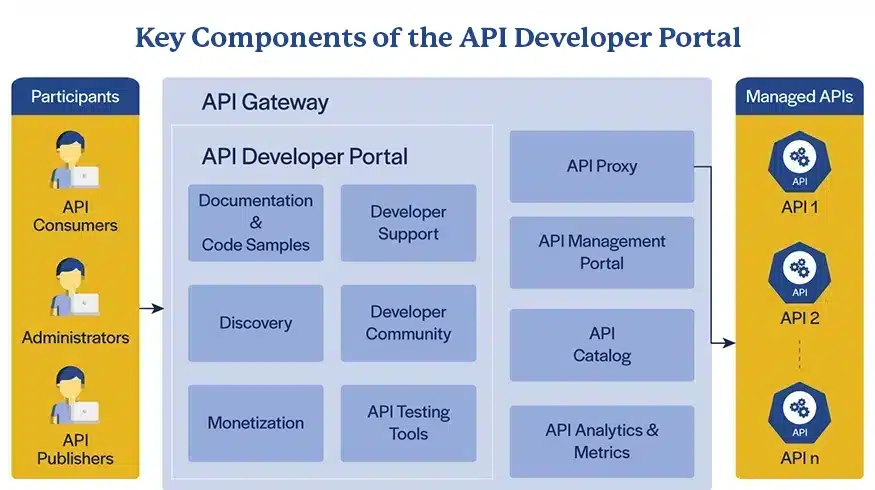
The evolution and adoption of enterprise digital transformation have made APIs critical for integration within and across enterprises as well as for product/service innovation. As APIs grow in scale and complexity, establishing a developer portal would significantly ease the process of their roll-out and adoption. This perspective paper explores the significance of an API Developer Portal in the modern digital landscape driving the API economy.
A Developer Portal makes it easier to understand APIs, reduces integration time, and supports developers in training and resolving API-related issues. This provides significant business value by improving agility and enhancing customer experience. With the help of a Portal, enterprises can efficiently publish and consume APIs and enable their integration with incremental API versions. This will ensure benefit from all digital investments.
In an increasingly API-driven economy, an all-inclusive API Developer Portal can differentiate an enterprise from its competitors, help build trust with partners, and achieve long-term success. Depending on the API platforms being used, enterprises could adopt a built-in platform or develop a custom one. Developing a custom API Portal would be easy at the start. However, developing enhanced features would entail a significant investment of time and resources. Hence, to make the right decisions and succeed in the broader API implementation/integration journey, a well-thought-out approach is necessary.
To learn more about the key drivers, components and features, implementation options and potential benefits of API Developer Portals, download the perspective paper here.

Cloud migration challenges and solutions
Insights into the top challenges and their mitigations in the cloud journey.
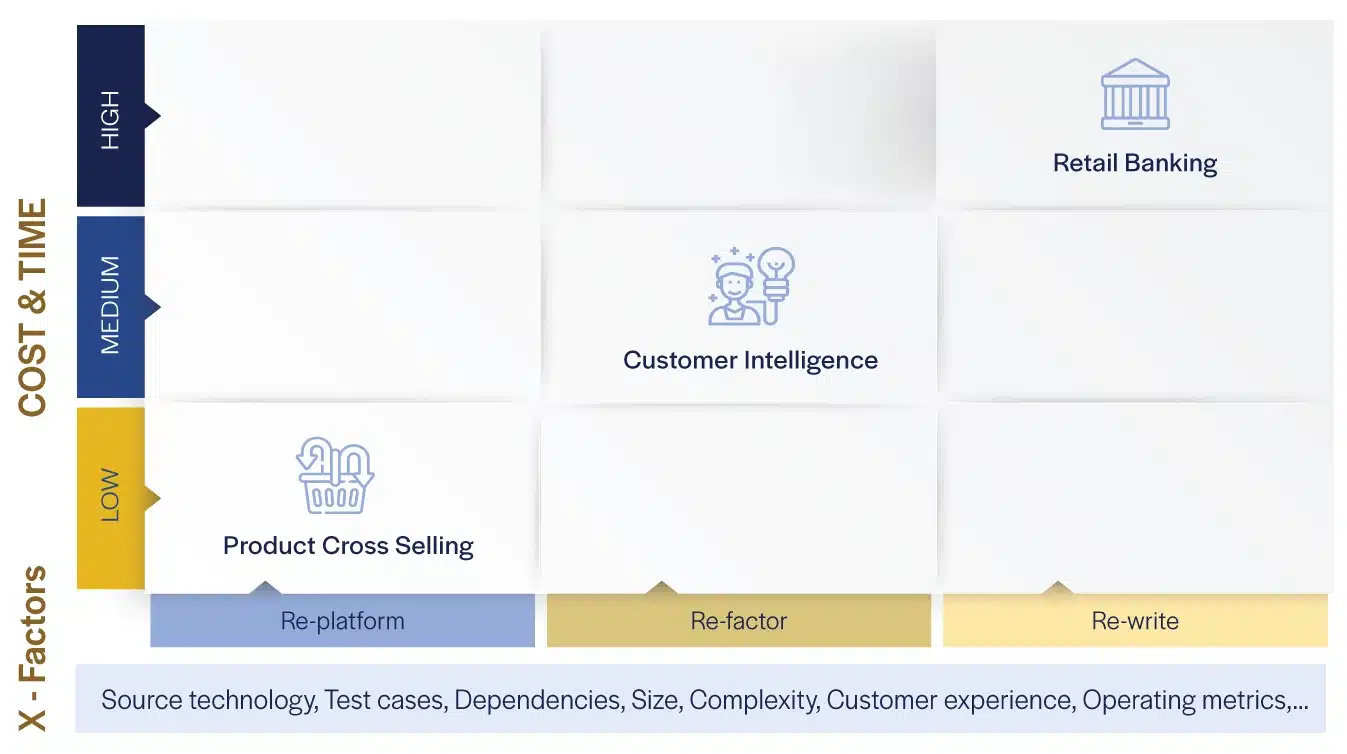
Selecting an appropriate path for an application or a portfolio of applications is one of the most critical decision points in a cloud journey. Assessing the nature and criticality of an existing application is usually the starting place. Another critical factor to consider is the implementation (migration) cost and time for each path to cloud. The four cloud adoption options are re-host, re-platform, re-factor and re-write in the order of increasing cost, effort, cloud benefits, and TCO reduction. Out of these, re-host usually does not involve code change and is relatively simple.
Mapping cloud operating metrics into a 3x3 matrix is a good starting point on planning for a cloud journey. In this matrix, the cloud operating metrics would move to the right if they are critical for customer intelligence applications; that would be an X factor. Another critical dimension while planning cloud migration is identifying the interface dependencies between selected application(s) and others – both inbound and outbound. These could be synchronous, asynchronous or batch.
Understanding the application architecture, its internal organization, and inter-dependencies are critical before migration. This can be a very complex and labor-intensive task if done manually and can be error prone. Not fully understanding the existing code can lead to issues related to transactions, data corruption, session handling, and performance.
To read more on the top challenges and their mitigations in the cloud journey, download the perspective paper here.
Order management platform transformation


Platform transformation and multi-cloud integration improve multinational publishing company's order management, time-to-market and performance.
Client
Multinational publishing, media, and educational company
Goal
Improve order management and transaction processing capabilities
Technology Tools
AWS EKS, Kong, Salesforce Commerce Cloud (SFCC), Salesforce CRM, Jenkins, Sumo Logic, Datadog
Business Challenge
The client's order management platform was complex and had scalability issues, causing poor customer experience and loss of revenue. The platform was hosted on Oracle cloud, with data stored in different repositories. Services were also hosted in the Oracle cloud, which used the BICC extract to fetch information about order details from Oracle databases. The low performance of customer-facing applications was causing latency and very high transaction processing time.
Solution
Team Iris transformed Oracle-based SOA services into six microservices and migrated them to AWS EKS for autoscaling with self-healing and monitoring capabilities.
We developed services for publishing data to Salesforce CRM for quick order processing and conversions. The BICC system for diversified information and order history was enabled with real-time integration between Oracle Fusion and materialized views for data consumption.
Post migration, these services were registered in Kong for discovery, and a CI/CD pipeline was created for deployment using Jenkins. Sumo Logic was used for monitoring the logs, and Datadog was used to observe latency, anomalies and other metrics.
Outcomes
The order management platform transformation delivered the following benefits to the client:
- System performance improved by 70%
- Transaction processing capability increased by 4x
- Order processing capabilities were enhanced by 200%
- Total cost of ownership (TCO) was reduced by 30%
Our experts can help you find the right solutions to meet your needs.
Explore the world with Iris. Follow us on social media today.
API migration benefits leading logistics company


Phased migration of Boomi APIs to Apigee helps a leading logistics company improve performance and scale without business disruption.
Client
A leader in truck transportation and logistics services
Goal
Migrate Boomi-based logistics APIs to improve performance and scalability
Technology Tools
Apigee, Boomi, Swagger, JMeter, Postman, GCP
Business Challenge
The client's existing Boomi Atom platform with logistics APIs had lifecycle and monitoring issues, with frequent and elongated downtimes, causing customer experience challenges.
The system did not support the logging of events, and API transactions were untraceable. Identifying the number of customers facing issues and incidents when APIs were not working was difficult. The absence of alerting mechanisms, scalability concerns, and the Boomi platform's high licensing costs were other critical challenges.
An optimized API governance system was required to provide an abstraction for the backend services, security, and efficiencies around rate limiting, quotas, and analytics.
Solution
Iris strategized the smooth transition of 250+ Boomi APIs, starting with 20 in the pilot phase. The entire migration was planned to occur in four waves.
First, the pseudocode of Boomi APIs was documented and reviewed. The team then developed proxies in Apigee X following a TDD (Test-driven Development) approach. A well-defined logging framework was provided to the client for capturing appropriate parameters for tracking API calls.
Seamless migration of API keys from Boomi API Management (APIM) to Apigee X apps was performed. Network routing at F5 for the individual proxies was implemented to transfer the traffic from Boomi to Apigee post migration in each wave. Process metering, monitoring, and adherence/compliance hooks were inserted into the system.
Outcomes
Our API migration solution delivered the following outcomes:
- Improved performance and scalability by 30%
- Centralized logging and alerting for both APIM and backend systems resulting in 40% MTTR (Mean Time for Ticket Resolution)
- Apigee analytics enablement for API traffic, request latency, response time, target errors, and transaction revenue analysis
- Enablement of API discovery, monetization, registration, partner onboarding, and governance
- Ability to integrate the system into the Apigee developer portal
- Eliminated Boomi licensing cost
Our experts can help you find the right solutions to meet your needs.
Explore the world with Iris. Follow us on social media today.
Brokerage platform transformation improves UX


A monolithic registered investment advisor (RIA) platform transformed into microservices helps a leading brokerage firm achieve enhanced operations and user experience.
Client
A leading U.S. brokerage firm with $1+ trillion in assets and serving 6,000+ RIAs
Goal
Resolve online platform accessibility, functionality and timeliness issues
Tools and Technologies
Angular 9, Jenkins, Pivotal Cloud Foundry, Oracle, Kubernetes, Spring, Docker
Business Challenge
Client’s existing brokerage platform supporting over 6,000 Registered Investment Advisors (RIAs) and containing information about assets valued at more than $1 trillion had accessibility issues. The high cost of owning and maintaining outdated technologies and time-to-market for new features were adding to the business challenges.
Solution
Iris transitioned the client’s monolith applications to microservices to transform the RIA platform. An open-source, cloud technical stack was leveraged to develop a single-page, micro-UI-based application. BFF (Backend for Frontend) design was applied, and Angular 9 was used to achieve superior compatibility on mobile devices.
Widgets were introduced to enable seamless transitions within third-party applications. Consolidated user views were created to track assets and their performance for a unified experience for the RIAs.
Outcomes
The RIA platform transformation enabled the client to achieve significant functional enhancements, including:
- Fully functional mobile views
- 100+ integrated third-party applications
- Instant and seamless access to client accounts
- Downtime for hot deployments of fixes brought to zero
- Technical debt decreased by 45%
- Release timelines shortened by 80%
- Issue resolution time reduced by 90%
Our experts can help you find the right solutions to meet your needs.
Explore the world with Iris. Follow us on social media today.
SFTR solution strengthened market leadership


Risk & Compliance
Securities financing transactions regulation compliance made easy
A global market data and trading services provider strengthens its EU market leadership with a regulatory solution by supporting a throughput of 6 million transactions per hour.
Client
A leading provider of market data and trading services
Goal
Support complex regulatory reporting with automated solution
Tools and Technologies
Java, Spring Boot, Apache Camel, CXF, Drools BRE, Oracle, JBoss Fuse, Elasticsearch, Git, Bitbucket, Sonar, Maven
Business Challenge
The client offers an automated, integrated solution to its clients in the European Union (EU) for complying with the Securities Financing Transactions Regulation (SFTR).
Effective in recent years, SFTR requires timely and detailed reporting based on multitudes of data, systems, collateral, and lifecycle events. The voluminous data is captured from hundreds of millions of daily transactions made to multiple trade repositories registered by the European Securities and Markets Authorities (ESMA).
Non-compliance at any stage is risky, potentially very costly, for all trade counterparties, i.e., broker-dealers, banks, asset managers, institutional investors.
Solution
Experienced in diverse technologies, big data, and capital markets, team Iris developed a streamlined, end-to-end data reporting platform with complex trade matching and monitoring systems. Improving speed, accuracy, and flexibility, the new architecture supports high trade concurrency and acceptance rates with parallel processing of millions of transactions.
The delivered solution also enabled optimal load balancing and matched the reconciliation at the trade repository. Built with microservices to accommodate future scalability, standardization, data quality, and security requirements, the system implemented functional enhancements. A Unique Transaction Identifier (UTI) subsystem was also developed for sharing and matching counterparty transactions, enabling plug-and-play setup for new repositories, and supporting any changes in outbound or inbound data report formats required by ESMA or clients. Improved dashboards and search pages helped the end-users in better configuration and tracking of their transactions.
Outcomes
The nimble delivery and successful roll-out of the new SFTR platform delivered the desired strategic competitive advantage to the client for maintaining its EU market leader position. The consolidated solution also helped in:
- Generating additional revenue from extending the new reporting services to 17 firms
- Beating the industry benchmark (~91%), achieving a higher transaction acceptance rate (~97%), and match reconciliation at the trade repository
- Supporting a high throughput of 6 million transactions per hour which is scalable up to 10 million
Our experts can help you find the right solutions to meet your needs.
Explore the world with Iris. Follow us on social media today.
Cloud transformation increases business agility


Existing applications supporting the business were built on monolith architecture with high technical debt. Iris transformed monolith applications that were more than 15 years old into microservices with automated integration and cloud deployment to deliver faster MVPs.
Client
A non-profit global organization responsible for developing and maintaining standards, including barcodes with over 115 local member organizations and over 2 million user companies
Goals
To deliver MVPs in shorter cycles, reduce Mean Time for Ticket Resolution (MTTR), and lower the total cost of ownership
Tools and Technologies
C#/.NET Core, Python/DJango, NodeJS/Express, Azure WAF, Azure APIM, App Services, Azure Kubernetes Service, Azure Monitor, and Application Insights
Business Challenge
The client had a suite of legacy applications to generate barcodes that are scanned globally over 6 million times a day.
These applications were built on monolithic architectures using heavy-weight application servers and outdated technologies. This architecture was causing long development cycles, making the organization less competitive. Developers’ productivity was also dropping due to high technical debt.
Solution
Azure cloud offered some of the foundational features like container orchestration, app engine, integration, API gateway, monitoring and others, making cloud-specific modernization a natural choice.
Modernization strategy involved reverse engineering of on-premise applications, domain-specific grouping the product backlogs by, adopting domain-driven design, and using open source cloud-friendly software with CI/CD pipeline. We transformed the applications to a .NET core framework using cloud-native design principles on Azure cloud. The solution was developed using Azure App Services, front door and service bus following the agile development approach with two-week sprints.
Outcomes
- Reduction in Mean Time for Ticket Resolution (MTTR) by 30%
- Increase in application and infrastructure uptime to 99.9%
- Real-time visibility of application and infra metrics
- Enabled bi-weekly MVP delivery
Our experts can help you find the right solutions to meet your needs.
Explore the world with Iris. Follow us on social media today.